
Quick answer
What Is Thoracic Aortic Aneurysm?
A thoracic aortic aneurysm is a widening of the aorta in the chest, anywhere from the aortic root to the descending aorta. It often causes no symptoms, can run in families or be linked to a bicuspid aortic valve, and needs monitoring to prevent a tear or rupture.
SourcesSigns That Need Urgent Help
- Sudden, very severe chest or back pain that feels like tearing
- Pain that moves or spreads to the back, abdomen, or neck
- Fainting, severe shortness of breath, or very low blood pressure
- Weakness on one side of the body, a drooping face, or difficulty speaking
- A clear difference in pulse or blood pressure between the right and left arms
- Pale, cold, sweaty skin with a fast pulse
If these signs appear, go to the nearest emergency department right away or call Heart Attack Center 1500 258.
01 / Understanding the condition
About Thoracic Aortic Aneurysm
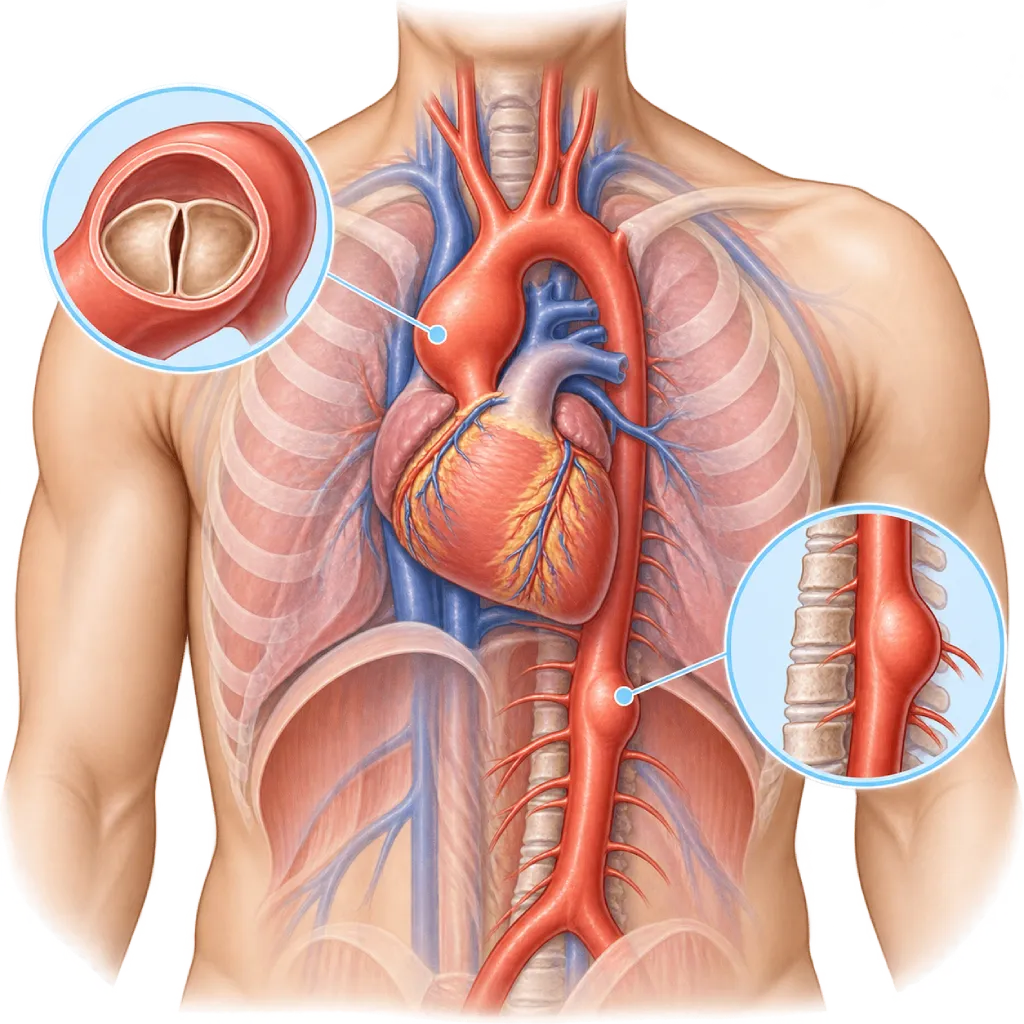
The thoracic aorta is the part of the aorta inside the chest. It is made up of the aortic root, where the aortic valve sits, the ascending aorta, the aortic arch, which gives off branches to the head and arms, and the descending aorta, which runs along the spine. A thoracic aortic aneurysm occurs when one of these segments becomes permanently widened. An ascending aorta that measures 4 cm or more generally already needs monitoring. An overview of aneurysms throughout the aorta is covered on the Aortic Aneurysm page.
Aortic Root and Ascending Aorta
Aneurysms of the aortic root and ascending aorta are more often influenced by inherited factors. Causes include a bicuspid aortic valve, meaning a valve with two leaflets instead of three, connective tissue disorders such as Marfan syndrome and Loeys-Dietz syndrome, Turner syndrome, and a family tendency without a clear syndrome. High blood pressure and age also play a role. Widening of the aortic root can pull on the aortic valve and cause it to leak.
Aortic Arch and Descending Aorta
Aneurysms of the descending aorta are more like abdominal aortic aneurysms, being linked to age, smoking, high blood pressure, and atherosclerosis. Some develop from an old tear in the aorta (chronic dissection) that gradually widens. When the widening extends down into the abdomen, the condition is called a thoracoabdominal aneurysm, covered on the Thoracoabdominal Aortic Aneurysm page.
Progression and Treatment
Thoracic aortic aneurysms generally grow slowly, about 1 millimeter per year in the ascending aorta and slightly faster in the descending aorta. They are often found during an echocardiogram, X-ray, or chest CT done for another reason. The risk of a tear or rupture increases with size. Surgery is generally considered at a diameter of about 5.5 cm, and earlier in connective tissue disorders, fast-growing aneurysms, or when the aortic valve also needs to be replaced. An aneurysm of the descending aorta can be repaired with a stent graft if its shape is suitable.
Family Screening
Because some thoracic aortic aneurysms are inherited, testing often does not stop with one person. If the cause is inherited, or the aneurysm appears at a young age without a clear cause, your doctor may recommend an echocardiogram or other imaging for parents, siblings, and children, as well as genetic counseling. This way, widening in other family members can be found earlier.
02 / Understanding the condition
Symptoms to Recognize.
Common Symptoms
Thoracic aortic aneurysms usually cause no symptoms. The complaints below appear when a large aneurysm presses on nearby organs or causes the aortic valve to leak.
- Persistent dull chest pain or upper back pain
- Hoarseness due to pressure on the nerve to the vocal cords
- Cough, wheezing, or shortness of breath due to pressure on the airway
- Difficulty swallowing due to pressure on the esophagus
- Shortness of breath and tiring easily when widening of the aortic root makes the aortic valve leak
03 / Understanding the condition
What Causes This Condition?
- A bicuspid aortic valve, which is often accompanied by widening of the ascending aorta
- Inherited connective tissue disorders, such as Marfan syndrome, Loeys-Dietz syndrome, or vascular Ehlers-Danlos syndrome
- A family tendency toward aneurysms even without a clear syndrome
- Aging of the aortic wall, high blood pressure, and atherosclerosis, especially in the descending aorta
- The remains of an old aortic tear (chronic dissection) that gradually widens
- Inflammation of the aortic wall, such as Takayasu arteritis or giant cell arteritis
- Turner syndrome, a chromosomal condition in females that is linked to widening of the aorta
04 / Understanding the condition
Who Is at Higher Risk?
Lifestyle
Smoking speeds up damage to the aortic wall, especially in the descending aorta. Using cocaine or other stimulants can raise blood pressure suddenly and trigger a tear.
Medical
High blood pressure, a bicuspid aortic valve, aortic valve disease, and a history of aortic dissection increase the risk of widening.
Genetic
Marfan syndrome, Loeys-Dietz syndrome, vascular Ehlers-Danlos syndrome, Turner syndrome, and a history of aortic aneurysm or dissection in close relatives.
Age
Aneurysms caused by aging are more common after age 60, while aneurysms caused by inherited conditions can appear from a young age.
Other
Pregnancy in women with a connective tissue disorder or an already widened aorta requires special planning and monitoring.
Groups at Higher Risk
- People with a Bicuspid Aortic Valve: Many people with a bicuspid valve develop widening of the ascending aorta, so the size of the aorta needs lifelong monitoring.
- People with Marfan Syndrome and Connective Tissue Disorders: The aorta can widen from a young age and needs treatment at a smaller size. Covered on the Marfan Syndrome page.
- Close Relatives of People with Aortic Aneurysm or Dissection: Thoracic aortic aneurysms can be inherited, so imaging and genetic counseling may be recommended.
- Older Adults with Hypertension: Long-term high blood pressure and aging strain the aortic wall, especially in the descending aorta.
- Women with Turner Syndrome: This chromosomal condition is linked to a bicuspid valve and widening of the aorta, including a risk of dissection during pregnancy.
05 / Understanding the condition
How Is It Diagnosed?
A thoracic aortic aneurysm is often found by chance, for example during an echocardiogram to assess a valve, a chest X-ray, or a chest CT for a lung complaint. Echocardiography is the initial test for the aortic root and ascending aorta, and it also shows whether the aortic valve is bicuspid or leaking. To see the arch and descending aorta, doctors use CT angiography or MRI, which are also used to measure the diameter in the same way over time.
A repeat scan is usually done six months after the aneurysm is found, then every year if its size is stable. If the aneurysm appears at a young age, there are features of a particular syndrome, or a family member has an aneurysm or dissection, your doctor may recommend genetic counseling and testing, as well as imaging for close relatives.
Echocardiography
Heart ultrasound to measure the aortic root and ascending aorta and assess the aortic valve; often the initial test and used for monitoring.
Aortic CT angiography: a CT scan with contrast dye to measure the entire thoracic aorta in detail and plan surgery or a stent graft.
Aortic MRI: imaging without X-rays for repeated monitoring, especially in young people with inherited conditions.
Chest X-Ray
A chest X-ray sometimes shows the shadow of a widened aorta, but a normal result does not rule out an aneurysm.
Aortic Angiography
A test using a catheter and contrast dye, especially when planning or performing stent graft placement.
Genetic counseling and testing: considered when an aneurysm appears at a young age or there is a family history, to look for a connective tissue disorder.
06 / Understanding the condition
Treatment Options.
Treatment is decided by a doctor after an assessment. The categories below can help you follow the conversation with your doctor.
Regular Monitoring
Echocardiography, CT, or MRI is repeated according to size, usually six months after the aneurysm is found and then every year if stable.
Blood Pressure Medication
Your doctor may prescribe a beta blocker or an angiotensin receptor blocker to reduce stress on the aortic wall, especially in Marfan syndrome. The type and dose are determined by your doctor.
Ascending Aorta Replacement
The widened part of the ascending aorta is replaced with a synthetic tube graft through open-heart surgery. Covered on the Aortic Surgery page.
Aortic Root and Valve Replacement
When the aortic root is widened and the valve is damaged, both are replaced together with a single valved tube graft, covered on the Bentall Procedure page. In some patients, the native valve can be preserved.
Descending Aorta Stent Graft
An aneurysm of the descending aorta can be repaired from inside the blood vessel, covered on the Aortic Stent Graft Placement (Endovascular Aortic Repair) page.
07 / Understanding the condition
Complications to Watch For.
Aortic Dissection
A sudden tear in the inner layer of the aortic wall that requires emergency treatment. Covered on the Aortic Dissection page.
Aneurysm Rupture
The thinned aortic wall can burst and cause bleeding inside the chest that requires immediate treatment.
Aortic Valve Leakage
Widening of the aortic root pulls on the valve so it does not close tightly and strains the heart, covered on the Aortic Regurgitation page.
Compression of the Airway and Esophagus
A large aneurysm can press on the airway, esophagus, or the nerve to the vocal cords, causing shortness of breath, difficulty swallowing, or hoarseness.
Blood Clots and Stroke
Clots or plaque in a widened aortic arch can break loose and travel to the arteries of the brain or legs.
08 / Understanding the condition
What Can You Do?
- Keep your blood pressure within the target agreed with your doctor
- Stop smoking and avoid cocaine and other stimulants
- People with a bicuspid valve or Marfan syndrome need regular monitoring of the aorta
- Close relatives of people with an aortic aneurysm or dissection can ask about screening
- Avoid very heavy lifting and straining while holding your breath
- Plan any pregnancy with your doctor if you are known to have a widened aorta
09 / Understanding the condition
When Should You See a Doctor?
A thoracic aortic aneurysm rarely causes symptoms, so checkups are important for people with inherited risk factors or a family history. Sudden, very severe chest or back pain that feels like tearing is an emergency sign: go to the nearest emergency room right away. Make an appointment if you:
- Have a bicuspid aortic valve, Marfan syndrome, or another connective tissue disorder
- Have a parent, sibling, or child with an aortic aneurysm or dissection
- Have been told your aorta is widened based on an echocardiogram, X-ray, or CT
- Have persistent hoarseness, cough, or difficulty swallowing without a clear cause
- Are planning a pregnancy and are known to have a widened aorta
Don't Wait in an Emergency.
If symptoms are severe or come on suddenly, go to the nearest emergency department right away or call Heart Attack Center 1500 258, rather than waiting for an appointment.
10 / Common questions
Questions You May Have.
Frequently asked questions about thoracic aortic aneurysm.
Is a thoracic aortic aneurysm the same as an enlarged heart?
No. An enlarged heart means the heart's chambers or muscle have grown larger, while a thoracic aortic aneurysm is a widening of the main artery that leaves the heart. Both can appear as a wide shadow on a chest X-ray, so they are sometimes confused. Widening of the aortic root can indeed make the aortic valve leak and, over time, strain the heart. An enlarged heart is covered on the Cardiomegaly page.
Why is a bicuspid aortic valve linked to aneurysms?
A bicuspid aortic valve is a valve that has had two leaflets since birth instead of three. In many people with this valve, the wall of the ascending aorta is also more fragile, and the blood flow leaving the unusual valve adds stress to the wall. As a result, the ascending aorta can widen, even after the valve has been replaced. For this reason, people with a bicuspid valve are advised to have the size of their aorta checked regularly, and their close relatives may be offered an echocardiogram.
At what size is a thoracic aortic aneurysm operated on?
For the ascending aorta, surgery is generally recommended at a diameter of about 5.5 cm. This threshold can be lower, about 4.5 to 5 cm, in Marfan syndrome, other connective tissue disorders, fast-growing aneurysms, a family history of dissection, or when the aortic valve also needs to be replaced. For the descending aorta, repair is generally considered at about 5.5 cm or more. Your doctor also takes your height and weight into account.
What medicines are used for a thoracic aortic aneurysm?
The goal of medication is to control blood pressure and reduce stress on the aortic wall. The classes often used are beta blockers and angiotensin receptor blockers, especially in Marfan syndrome. These medicines do not shrink the aneurysm and do not replace surgery once its size reaches the threshold. The type, combination, and dose are decided by your doctor, so do not stop or change your medicines on your own.
Is it safe to exercise with a thoracic aortic aneurysm?
Light to moderate aerobic activity, such as walking, easy cycling, or swimming, is generally safe and beneficial. Avoid heavy weightlifting, contact sports, and straining while holding your breath, because blood pressure can spike and put stress on the aorta. People with Marfan syndrome or a large aneurysm usually need stricter limits. Discuss the type and intensity of exercise with your doctor.
Can a woman with a thoracic aortic aneurysm become pregnant?
Pregnancy adds strain to the aorta, so it needs to be planned with a cardiologist and an obstetrician. In Marfan syndrome or when the aorta is already fairly wide, your doctor may suggest surgery before pregnancy. During pregnancy, the size of the aorta is monitored regularly with echocardiography, and the method of delivery is planned according to the condition of the aorta. Do not stop your medicines on your own when you find out you are pregnant, but consult your doctor promptly because some medicines need to be changed.
Sources and Medical Review
Translated from the Indonesian edition medically reviewed by dr. Suko Adiarto, Sp.JP(K), Ph.D..
Sources as cited in the Indonesian edition.
- Isselbacher EM, Preventza O, Hamilton Black J, et al. 2022 ACC/AHA Guideline for the Diagnosis and Management of Aortic Disease: A Report of the American Heart Association/American College of Cardiology Joint Committee on Clinical Practice Guidelines. Circulation. 2022;146(24):e334-e482.
- Mazzolai L, Teixido-Tura G, Lanzi S, et al. 2024 ESC Guidelines for the management of peripheral arterial and aortic diseases. Eur Heart J. 2024;45(36):3538-3700.
- Czerny M, Grabenwöger M, Berger T, et al. EACTS/STS Guidelines for diagnosing and treating acute and chronic syndromes of the aortic organ. Eur J Cardiothorac Surg. 2024;65(2):ezad426.
- Riambau V, Böckler D, Brunkwall J, et al. Management of Descending Thoracic Aorta Diseases: Clinical Practice Guidelines of the European Society for Vascular Surgery (ESVS). Eur J Vasc Endovasc Surg. 2017;53(1):4-52.
- Otto CM, Nishimura RA, Bonow RO, et al. 2020 ACC/AHA Guideline for the Management of Patients With Valvular Heart Disease: A Report of the American College of Cardiology/American Heart Association Joint Committee on Clinical Practice Guidelines. Circulation. 2021;143(5):e72-e227.
Doctors Who Treat This Condition

dr. Widya T. Suwatri, Sp.BTKV, Subsp. JD(K)
Adult Cardiac Surgery
Advanced Cardiovascular Surgical Care +1 center
Clinical focusMinimally Invasive Cardiac Surgery · Coronary Artery Bypass Surgery
View Profile
dr. Suko Adiarto, Sp.JP(K), Ph.D.
Interventional Cardiology
Vascular Diagnostic and Therapeutic Center +1 center
Clinical focusCoronary Intervention · Peripheral Vascular Intervention
View Profile
dr. BRM Ario S. Kuncoro, Sp.JP(K)
Echocardiography & Cardiovascular Imaging
Cardiovascular Diagnostic Center +2 centers
Clinical focusAdvanced and 3D Echocardiography · Transesophageal Echocardiography
View Profile