
Quick answer
What Is Cerebral Aneurysm?
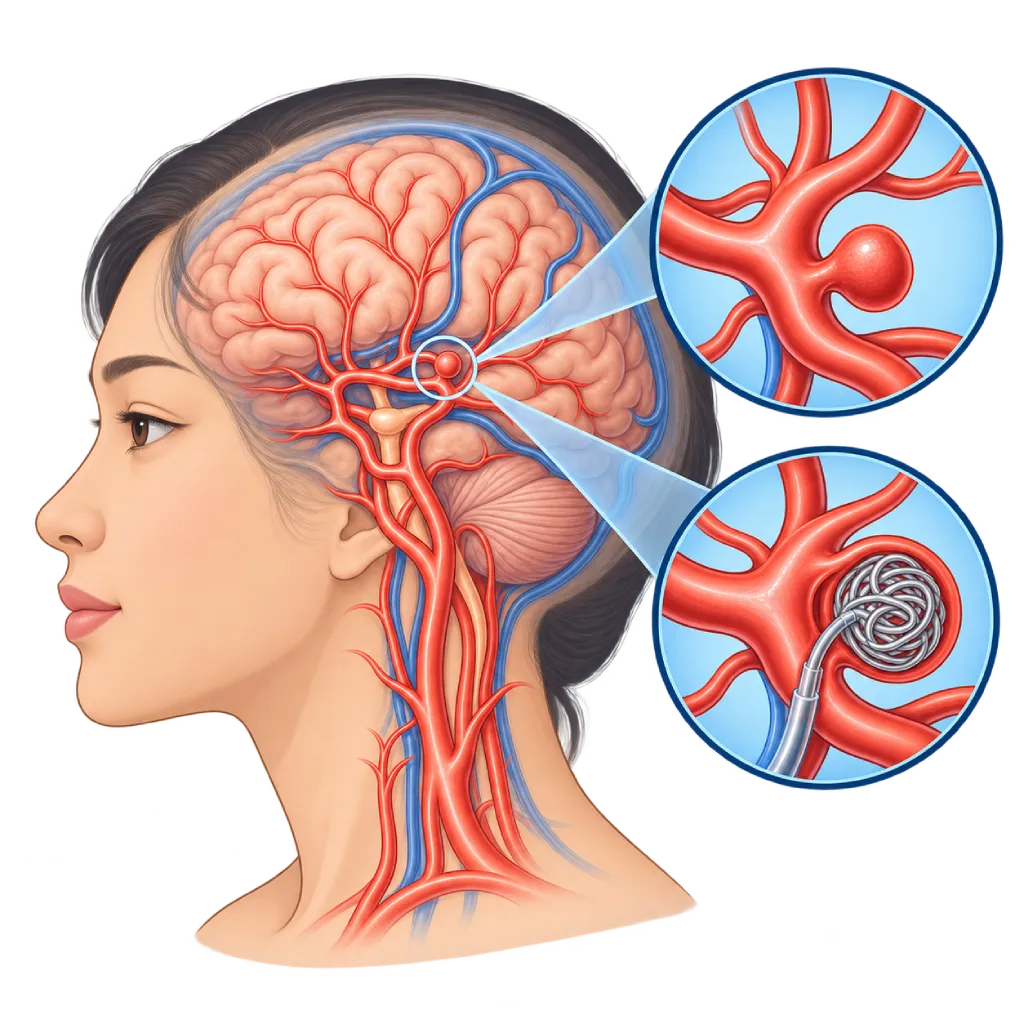
A cerebral aneurysm is a small bulge in a weakened artery wall inside the head. The majority cause no symptoms and never rupture, but if one ruptures, it can cause bleeding around the brain that needs emergency care.
SourcesSigns That Need Urgent Help
- A sudden, extremely severe headache that comes on within seconds
- Nausea and vomiting along with a sudden headache
- Stiff neck and sensitivity to light
- Fainting, confusion, or reduced consciousness
- A seizure for the first time
- Weakness on one side of the body or difficulty speaking
If these signs appear, go to the nearest emergency department right away or call Heart Attack Center 1500 258.
01 / Understanding the condition
About Cerebral Aneurysm
A cerebral aneurysm, often called a brain aneurysm, is a bulge in the wall of an artery inside the head. The common form looks like a small berry attached at a branching point of the arteries at the base of the brain, where the artery wall receives strong pressure from blood flow. It is usually smaller than 1 cm. Research estimates that about 3 in 100 adults have an unruptured cerebral aneurysm, and the majority never know it. An overview of aneurysms in other parts of the body is covered on the Aneurysm page.
Unruptured Aneurysms
Cerebral aneurysms are usually found by chance during a head CT or MRI done for another complaint. The majority of small aneurysms never rupture. The risk of rupture is assessed from the size, location, shape, growth, age, blood pressure, and any previous bleeding. A large aneurysm sometimes presses on nearby nerves, such as the nerve that moves the eye, causing a drooping eyelid or double vision. New complaints like these need to be checked right away.
When an Aneurysm Ruptures
A ruptured aneurysm releases blood into the space between the brain and its covering membranes, called a subarachnoid hemorrhage. This is one form of bleeding stroke, covered on the Hemorrhagic Stroke page. The typical symptom is an extremely severe headache that comes on within seconds, often with vomiting, a stiff neck, or reduced consciousness. This is an emergency: the aneurysm needs to be secured quickly so it does not bleed again, and the patient is cared for in intensive care to prevent complications.
Who Treats It
Cerebral aneurysms are treated by neurologists, neurosurgeons, and a neurointerventional team. The link with heart and blood vessel health lies in shared risk factors, mainly high blood pressure and smoking. For this reason, controlling blood pressure and quitting smoking are an important part of treatment, both before and after a procedure.
Living with an Unruptured Aneurysm
People with a small aneurysm that is being monitored can usually go about their daily activities as normal. What matters is attending scheduled follow-up imaging, controlling blood pressure, quitting smoking, limiting alcohol, and recognizing the warning signs. If the aneurysm grows or changes shape, your doctor will discuss treatment options with you again.
02 / Understanding the condition
Symptoms to Recognize.
Common Symptoms
Unruptured aneurysms usually cause no symptoms. The following complaints can appear when an aneurysm enlarges and presses on nerves or brain tissue.
- Drooping eyelid on one side
- Double or blurred vision
- The pupil of one eye looks wider
- Pain around or behind one eye
- A new, persistent headache that feels different from usual
- Numbness or weakness on one side of the face
03 / Understanding the condition
What Causes This Condition?
- Weakness of the artery wall at branching points of the brain's blood vessels, partly present from birth
- High blood pressure that has gone uncontrolled for a long time
- Damage to the artery wall from smoking
- Inherited conditions such as polycystic kidney disease or connective tissue disorders
- Infection of a heart valve that spreads germs to the brain arteries, covered on the Infective Endocarditis page
- Severe head injury, although this is rare
04 / Understanding the condition
Who Is at Higher Risk?
Lifestyle
Smoking and excessive alcohol use increase the risk of an aneurysm forming and rupturing. Using cocaine or stimulants can trigger surges in blood pressure.
Medical
High blood pressure, polycystic kidney disease, and a previous subarachnoid hemorrhage increase the risk.
Genetic
Two or more close relatives with a cerebral aneurysm or subarachnoid hemorrhage, as well as inherited connective tissue disorders.
Age
Cerebral aneurysms are usually found in adults, more often after age 40, and rarely in children.
Other
Women are affected more often than men, especially after menopause.
Groups at Higher Risk
- Close Relatives of People with a Cerebral Aneurysm: The risk is higher when two or more close relatives have had one, so screening may be considered.
- People with Polycystic Kidney Disease: This inherited kidney condition is linked to cerebral aneurysms, especially when there is a family history.
- People with Hypertension Who Smoke: The combination of high blood pressure and smoking increases the risk of an aneurysm forming, growing, and rupturing.
- Women Over Age 50: Cerebral aneurysms are found more often in women, especially after menopause.
- Survivors of Subarachnoid Hemorrhage: People who have had bleeding from an aneurysm can develop new aneurysms, so long-term monitoring is recommended.
05 / Understanding the condition
How Is It Diagnosed?
Testing depends on the situation. If someone has a sudden, extremely severe headache, a head CT without contrast is done right away to look for bleeding. If the CT is normal but suspicion remains high, the doctor may perform a lumbar puncture. Once bleeding is found, CT angiography or catheter-based cerebral angiography is used to find the aneurysm causing it and to plan treatment.
Unruptured aneurysms are usually found by chance. The doctor then assesses their size, location, and shape with MR angiography or CT angiography, asks about family history, smoking, and blood pressure, and then estimates the risk of rupture. Screening may be considered for people who have two or more close relatives with a cerebral aneurysm, and for people with polycystic kidney disease.
Physical Examination
The doctor checks blood pressure, consciousness, eye movements, pupils, limb strength, and signs of neck stiffness.
Head CT without contrast: the first test when bleeding is suspected, because it is fast and can be done right away.
Head CT angiography: a CT scan with contrast dye to view the brain's blood vessels and locate the aneurysm.
Brain MR angiography: imaging without X-rays to find and monitor unruptured aneurysms.
Cerebral angiography (DSA): a test using a catheter and contrast dye to see the shape of the aneurysm in detail, often done as part of the treatment procedure at the same time.
Lumbar puncture: removal of a small amount of the fluid around the brain and spinal cord from the lower back, when the CT is normal but bleeding is still suspected.
06 / Understanding the condition
Treatment Options.
Treatment is decided by a doctor after an assessment. The categories below can help you follow the conversation with your doctor.
Monitoring with Imaging
Small aneurysms with a low risk of rupture are monitored with regular MR angiography or CT angiography, along with control of risk factors.
Blood Pressure Control and Quitting Smoking
Basic steps to lower the risk of an aneurysm growing and rupturing. Blood pressure medicines are chosen and dosed by your doctor.
Endovascular Coiling
Fine metal coils are placed inside the aneurysm through a catheter from an artery in the arm or groin, sealing the aneurysm from the inside.
Flow Diverter
A special stent with a dense mesh is placed in the parent artery to divert blood flow away from the aneurysm, especially for wide or large aneurysms.
Neurosurgical Clipping
A neurosurgeon opens the skull and places a small clip across the neck of the aneurysm so blood no longer flows into it.
Intensive Care After Rupture
Patients are treated in intensive care to secure the aneurysm, prevent narrowing of the brain's blood vessels, and manage buildup of brain fluid.
07 / Understanding the condition
Complications to Watch For.
Subarachnoid Hemorrhage
Bleeding into the space around the brain from a ruptured aneurysm, an emergency covered on the Hemorrhagic Stroke page.
Rebleeding
A ruptured aneurysm can bleed again in the first days if it has not been secured, so treatment is given as quickly as possible.
Narrowing of Brain Blood Vessels
Several days after the bleeding, brain arteries can narrow (vasospasm) and reduce blood flow to the brain, so patients are closely monitored.
Hydrocephalus
Blood can block the flow of brain fluid, so fluid builds up and presses on the brain; a drainage tube is sometimes needed.
Seizures and Brain Function Problems
Bleeding can cause seizures or problems with memory, concentration, or movement that need rehabilitation.
Pressure on Eye Nerves
A large unruptured aneurysm can press on the nerve that moves the eye, causing a drooping eyelid or double vision.
08 / Understanding the condition
What Can You Do?
- Control your blood pressure and measure it regularly at home
- Quit smoking and avoid secondhand smoke
- Limit alcohol and avoid cocaine and stimulants
- If two or more close relatives have had a brain aneurysm, ask whether you need screening
- If you have polycystic kidney disease, you can ask about checking the blood vessels in your brain
- If you already know you have an aneurysm, attend your scheduled follow-up imaging
09 / Understanding the condition
When Should You See a Doctor?
An extremely severe headache that comes on suddenly, unlike the headaches you usually have, is an emergency sign: go to the nearest emergency room right away or call 119, even if the pain starts to ease. For situations that are not emergencies, make an appointment with a neurologist if you:
- Have been told you have an aneurysm from a head CT or MRI
- Have two or more close relatives with a brain aneurysm or subarachnoid hemorrhage
- Have polycystic kidney disease
- Notice a new drooping eyelid, double vision, or pain around the eye
- Have a new headache that persists and feels different from usual
Don't Wait in an Emergency.
If symptoms are severe or come on suddenly, go to the nearest emergency department right away or call Heart Attack Center 1500 258, rather than waiting for an appointment.
10 / Common questions
Questions You May Have.
Frequently asked questions about cerebral aneurysms.
Will every brain aneurysm rupture?
No. The majority of small cerebral aneurysms never rupture in a person's lifetime. The risk of rupture is higher for aneurysms that are larger, located in certain arteries, irregular in shape, or still growing, or in people with high blood pressure, a smoking habit, or previous bleeding. Doctors use this information to recommend monitoring or preventive treatment.
What does the headache from a ruptured aneurysm feel like?
The headache usually comes on very suddenly, peaks within seconds to a minute, and feels extremely severe, often described as being struck or as an explosion in the head. It often comes with nausea, vomiting, a stiff neck, sensitivity to light, or fainting. A headache like this needs urgent evaluation in the emergency room, even if it later eases, because some people have a small bleed before a larger one.
What is the difference between coiling and clipping?
Coiling is done from inside the blood vessel: a catheter is passed through an artery in the arm or groin up to the brain, and fine metal coils then fill the aneurysm. Clipping is a neurosurgical operation in which the skull is opened and a clip is placed across the neck of the aneurysm. Coiling usually has a shorter recovery, while clipping less often needs a repeat procedure. The choice depends on the shape and location of the aneurysm and your condition.
Does my family need to be checked?
Screening may be considered if two or more close relatives, such as parents, siblings, or children, have had a cerebral aneurysm or subarachnoid hemorrhage. If only one family member is affected, screening is generally not routinely recommended unless there are other factors such as polycystic kidney disease. Screening usually uses MR angiography. Discuss the benefits, including the possibility of anxiety from a small finding, with a neurologist before deciding.
How are brain aneurysms related to heart and blood vessel disease?
Cerebral aneurysms and heart disease share the same risk factors, mainly high blood pressure and smoking. Controlling blood pressure protects the heart, kidneys, and brain blood vessels at the same time. People with an aneurysm also need to mention it if they are going to take blood thinners for a heart problem, so the cardiologist and neurologist can weigh the benefits and risks together.
Can people with an unruptured brain aneurysm exercise?
In general, yes. Moderate physical activity such as walking, easy cycling, or swimming helps control blood pressure. Avoid heavy straining or lifting very heavy weights, because blood pressure can rise suddenly. Follow your neurologist's specific advice, especially if the aneurysm is large or a procedure is being planned.
Sources and Medical Review
Translated from the Indonesian edition medically reviewed by dr. Emanoel Oepangat, Sp.JP(K).
Sources as cited in the Indonesian edition.
- Hoh BL, Ko NU, Amin-Hanjani S, et al. 2023 Guideline for the Management of Patients With Aneurysmal Subarachnoid Hemorrhage: A Guideline From the American Heart Association/American Stroke Association. Stroke. 2023;54(7):e314-e370.
- Etminan N, de Sousa DA, Tiseo C, et al. European Stroke Organisation (ESO) guidelines on management of unruptured intracranial aneurysms. Eur Stroke J. 2022;7(3):LXXXI-CVI.
- Thompson BG, Brown RD Jr, Amin-Hanjani S, et al. Guidelines for the Management of Patients With Unruptured Intracranial Aneurysms: A Guideline for Healthcare Professionals From the American Heart Association/American Stroke Association. Stroke. 2015;46(8):2368-2400.
- Claassen J, Park S. Spontaneous subarachnoid haemorrhage. Lancet. 2022;400(10355):846-862.
- Hackenberg KAM, Hänggi D, Etminan N. Unruptured Intracranial Aneurysms. Stroke. 2018;49(9):2268-2275.
- Vlak MH, Algra A, Brandenburg R, Rinkel GJ. Prevalence of unruptured intracranial aneurysms, with emphasis on sex, age, comorbidity, country, and time period: a systematic review and meta-analysis. Lancet Neurol. 2011;10(7):626-636.
Doctors Who Treat This Condition

dr. Indah A. Putri, Sp.N, Subsp, NIOO(K), MSc
Neurovascular, Interventional, Otology, Imaging, and Ophthalmology
Clinical focusStroke and Cerebrovascular Disease · Neurosonology
View Profile
dr. Suko Adiarto, Sp.JP(K), Ph.D.
Interventional Cardiology
Vascular Diagnostic and Therapeutic Center +1 center
Clinical focusCoronary Intervention · Peripheral Vascular Intervention
View Profile
dr. Emanoel Oepangat, Sp.JP(K)
Interventional Cardiology
Vascular Diagnostic and Therapeutic Center +1 center
Clinical focusCoronary Intervention · Peripheral Vascular Intervention
View Profile