
Quick answer
What Is Degenerative Heart Valve Disease?
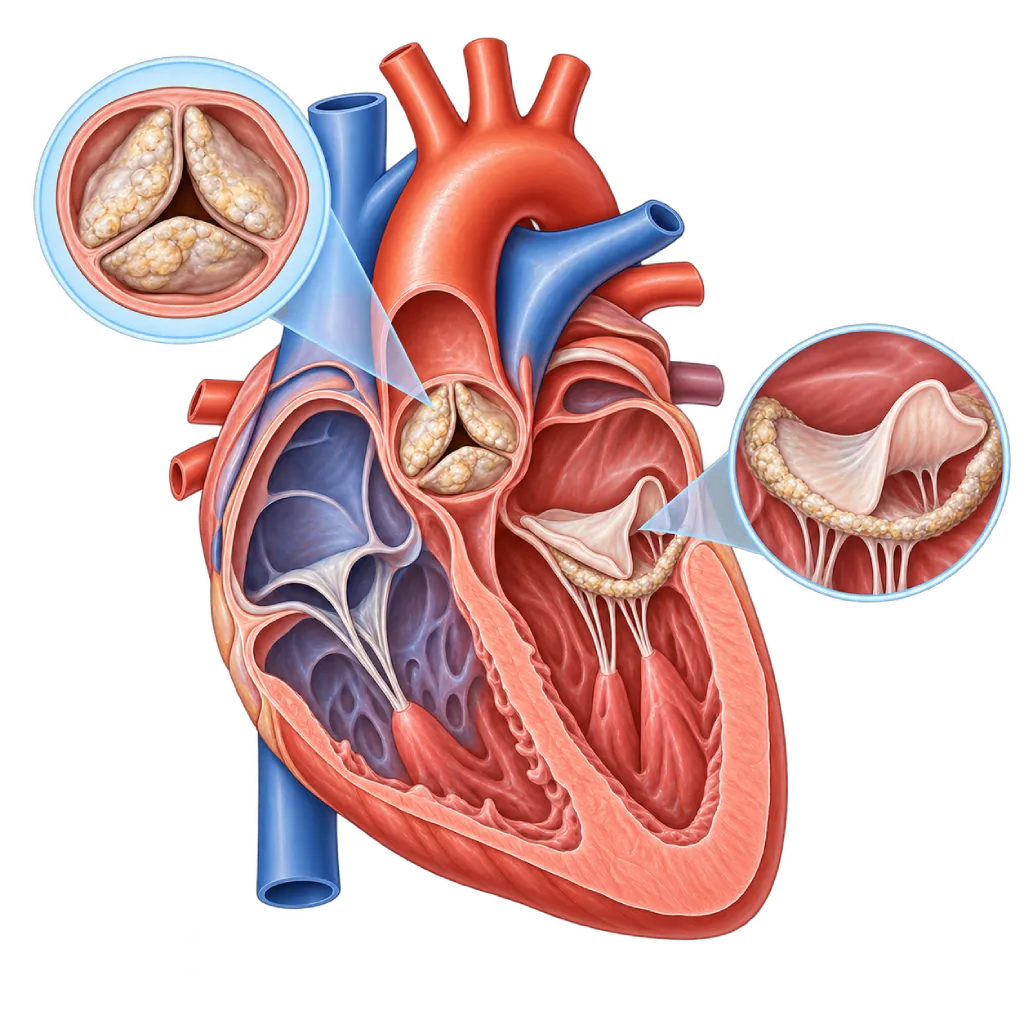
Degenerative heart valve disease is valve damage that develops slowly with age, in the form of calcification, thickening, or weakening of the valve tissue. As a result, a valve can narrow or leak, especially the aortic and mitral valves.
SourcesSigns That Need Urgent Help
- Fainting, especially during or shortly after activity
- Severe chest pain that does not ease with rest
- Severe shortness of breath at rest or being unable to lie down
- Coughing up pink, frothy sputum
- A very fast heartbeat with weakness, dizziness, or shortness of breath
- Sudden weakness on one side of the body, a drooping face, or slurred speech
If these signs appear, go to the nearest emergency department right away or call Heart Attack Center 1500 258.
01 / Understanding the condition
About Degenerative Heart Valve Disease
Each heart valve opens and closes about 100,000 times a day. With age, valve tissue can change slowly: it can thicken, harden from calcium deposits, or instead become floppy and loose. These changes caused by aging and wear are called degenerative heart valve disease. In developed countries, degeneration is the main cause of valve disease in adults, and the number of cases is growing as life expectancy increases.
Two Patterns of Valve Degeneration
The first pattern is calcification. In the aortic valve, the process begins with mild thickening called aortic sclerosis, then can progress to a stiff valve that does not open fully, which is covered on the Aortic Stenosis page. Calcification can also affect the ring of the mitral valve (mitral annular calcification), which sometimes causes the mitral valve to narrow or leak.
The second pattern is degeneration of the mitral valve tissue. In older age, the valve leaflets tend to become thin and their supporting cords (chordae) break easily. At a younger age, the leaflets can become thickened and excessive (myxomatous degeneration). The leaflets then bulge back into the left atrium or the cords break, so the valve leaks. These conditions are covered on the Mitral Valve Prolapse page and on the Mitral Regurgitation page.
Factors That Speed It Up
Valve calcification is not simply a result of age. The process resembles hardening of the arteries and is triggered by similar factors, such as high blood pressure, high LDL cholesterol and lipoprotein(a), smoking, diabetes, and chronic kidney disease. An aortic valve that has only two leaflets from birth (bicuspid) calcifies faster, so narrowing can appear at age 50 to 60.
Course of the Disease
Valve degeneration develops over many years, and many people have no symptoms in the early stages. The problem is often discovered from a heart murmur during a routine checkup. Once it is severe, shortness of breath, chest pain, or fainting during activity signal that the heart is starting to struggle. Cholesterol-lowering medicines still benefit the heart and blood vessels, but no medicine has yet been proven to stop valve calcification. For this reason, in the severe stage, treatment is valve repair or replacement, through surgery or through a catheter.
02 / Understanding the condition
Symptoms to Recognize.
Common Symptoms
- Shortness of breath during activity or when climbing stairs
- Tiring easily and a reduced ability to be active
- Pain or pressure in the chest during activity
- Dizziness or lightheadedness during activity
- A pounding heartbeat or a rhythm that feels irregular
- Swelling in the ankles or legs
- A heart murmur found by your doctor even before any symptoms appear
Symptoms in Older Adults
In older adults, symptoms are often put down to age, when they may actually be a sign of a narrowed or leaking valve.
- Cutting back on activity without realizing it because of tiring quickly
- Walking more slowly or stopping often to catch your breath
- Unsteadiness, falling easily, or nearly fainting
- Waking at night because of shortness of breath or coughing
03 / Understanding the condition
What Causes This Condition?
- Calcification (calcium deposits) on the aortic valve leaflets that develops with age
- Calcification of the mitral valve ring (mitral annular calcification)
- Mitral valve leaflets that become thin or thickened, with supporting cords (chordae) that weaken or break
- A bicuspid (two-leaflet) aortic valve present from birth that calcifies faster
- A process similar to hardening of the arteries, triggered by high blood pressure, high cholesterol, and smoking
- Late effects of radiation therapy to the chest area, for example in cancer treatment
04 / Understanding the condition
Who Is at Higher Risk?
Age
The risk increases after age 65. Mild calcification of the aortic valve and changes in the mitral valve tissue are fairly common in older age, although not all of them progress to severe disease.
Medical
High blood pressure, high LDL cholesterol, diabetes, chronic kidney disease (especially in people on dialysis), and disorders of calcium and phosphate metabolism speed up valve calcification.
Genetic
A bicuspid aortic valve can be found in more than one family member. High lipoprotein(a) levels are inherited in families and are linked to aortic valve calcification.
Lifestyle
Smoking and a lifestyle that raises blood pressure and cholesterol are linked to aortic valve calcification, as in hardening of the arteries.
Other
A history of radiation therapy to the chest area, for example for lymphoma or breast cancer, can damage the valves years later.
Groups at Higher Risk
- Older Adults: Aortic valve calcification and changes in the mitral valve tissue become increasingly common after age 65, often without noticeable symptoms.
- People with a Bicuspid Aortic Valve: A two-leaflet valve calcifies faster, so narrowing can appear one to two decades earlier.
- People with Chronic Kidney Disease: Disordered calcium and phosphate metabolism speeds up calcification of the aortic valve and the mitral valve ring, especially in dialysis patients.
- Survivors of Chest Radiation Therapy: Radiation to the chest area can slowly damage the valves, with symptoms that appear only years later.
- People with Hypertension and High Cholesterol: The factors that damage blood vessels are also linked to aortic valve calcification.
05 / Understanding the condition
How Is It Diagnosed?
Valve degeneration is often first suspected from a heart murmur heard during a routine checkup. Echocardiography, a heart ultrasound, then confirms which valve is affected, whether it is narrowed or leaking, how severe it is, and how strongly the heart is pumping. These results determine the schedule for your next follow-up.
If the echocardiography result is not conclusive, for example when the heart's pumping is weak, your doctor may use echocardiography with a medicine that stimulates the heart, or a CT scan to measure the amount of calcium in the aortic valve. An exercise test helps confirm whether a patient truly has no symptoms. Before a procedure, a CT scan is used to measure the valve and the blood vessels the catheter will pass through, and the coronary arteries are examined with angiography or coronary CT.
Physical Examination
Your doctor listens for a heart murmur with a stethoscope and checks your pulse, blood pressure, and signs of fluid buildup.
Echocardiography
The main test to see calcification and leaflet movement, measure the degree of narrowing or leakage, and assess the strength of the heart's pumping.
Electrocardiogram (ECG)
Looks for atrial fibrillation, heart conduction disorders, and signs of a thickened heart muscle.
Cardiac CT Scan
Measures the amount of calcium on the aortic valve when the degree of narrowing is unclear, and helps plan valve replacement through a catheter.
Treadmill Stress Test
An exercise test to confirm whether severe valve disease is truly without symptoms, at the doctor's discretion.
NT-proBNP and BNP Test
A blood test for markers of heart strain that helps assess disease progression and the timing of a procedure.
Coronary Angiography
Examines the coronary arteries before surgery or a valve procedure, because coronary artery disease often occurs alongside it in older age.
06 / Understanding the condition
Treatment Options.
Treatment is decided by a doctor after an assessment. The categories below can help you follow the conversation with your doctor.
Regular Monitoring
Mild to moderate degeneration is monitored with regular checkups and echocardiography, from every few years to every 6 to 12 months depending on its severity.
Risk Factor Control
Blood pressure, cholesterol, and blood sugar are still kept under control for the health of the heart and blood vessels, although medicines have not been proven to stop valve calcification.
Medicines to Relieve Symptoms
Diuretics, rhythm-control medicines, and blood thinners when atrial fibrillation is present help relieve symptoms and prevent complications, but they do not repair the valve. Your doctor determines the drug class and dose.
Aortic Valve Replacement
Severe aortic valve narrowing is treated with surgical valve replacement or a valve implanted through a catheter (TAVI), chosen by the heart team based on age, anatomy, and surgical risk.
Mitral Valve Repair or Replacement
Severe degenerative mitral leakage is usually repaired with surgery while preserving the native valve, or with a clip placed through a catheter when surgical risk is high.
07 / Understanding the condition
Complications to Watch For.
Heart Failure
Years of extra strain cause the heart muscle to thicken or enlarge and then weaken, leading to shortness of breath and swelling. Covered on the Heart Failure page.
Atrial Fibrillation
An enlarged left atrium, especially in mitral valve disease, is prone to an irregular rhythm that adds to the risk of stroke. Covered on the Atrial Fibrillation page.
Fainting During Activity
In severe aortic valve narrowing, blood flow to the brain can drop during activity. Fainting is a sign that a valve procedure should be considered promptly.
Heart Conduction Disorders
Calcification can extend into the heart's electrical pathway near the valve, slowing the heartbeat. Covered on the Atrioventricular Block page.
Infective Endocarditis
Damaged valves are more easily colonized by germs from the bloodstream. Covered on the Infective Endocarditis page.
08 / Understanding the condition
What Can You Do?
- Control your blood pressure to the target recommended by your doctor
- Have your cholesterol checked, including lipoprotein(a) if your doctor suggests it, and keep your levels under control
- Stop smoking and stay physically active according to your ability
- Have an echocardiogram if your doctor finds a heart murmur, even if you have no symptoms
- Once diagnosed, attend follow-up visits as scheduled and report new symptoms promptly
- Keep your teeth and mouth clean to lower the risk of valve infection
09 / Understanding the condition
When Should You See a Doctor?
See a cardiologist if a doctor finds a heart murmur, especially after age 60, or if you start to tire easily, become short of breath, or feel dizzy during activities that used to feel light. These symptoms are easily put down to age, when they may actually come from a valve. Go to the emergency room right away if you faint, have severe chest pain, or have severe shortness of breath at rest.
- Shortness of breath, chest pain, or dizziness when walking or climbing stairs
- Fainting or nearly fainting during activity
- Leg swelling or rapid weight gain over a few days
- A diagnosis of valve narrowing or leakage without regular follow-up
- Plans for another surgery in a person with known aortic valve narrowing
Don't Wait in an Emergency.
If symptoms are severe or come on suddenly, go to the nearest emergency department right away or call Heart Attack Center 1500 258, rather than waiting for an appointment.
10 / Common questions
Questions You May Have.
Frequently asked questions about degenerative heart valve disease.
Can degenerative heart valve disease be slowed with medicine?
So far, no medicine has been proven to stop or slow valve calcification. Statin cholesterol-lowering medicines are still beneficial for preventing heart attack and stroke, but studies have not shown that statins slow the narrowing of the aortic valve. For this reason, the key to treatment is regular monitoring and a valve procedure at the right time once the disease has become severe.
Does everyone develop valve degeneration in old age?
No. Mild changes in the valves are fairly common in older age and generally do not interfere with how the heart works. Only some progress to severe narrowing or leakage. The pace differs for each person and is influenced by factors such as a bicuspid valve, kidney disease, and the amount of calcium on the valve. Regular echocardiography helps your doctor monitor whether the changes in your valve are progressing.
Does old age rule out valve replacement?
Age alone is not a reason to refuse a procedure. The heart team assesses the patient's general condition, other illnesses, fitness, and preferences. For older people or those at high risk from surgery, aortic valve replacement through a catheter (TAVI) is an option because it does not require opening the chest. The 2021 ESC/EACTS guidelines list age 75 and older as one of the considerations for choosing TAVI.
How does the doctor decide when to treat?
A procedure is generally considered when the narrowing or leakage is severe and causes symptoms such as shortness of breath, chest pain, or fainting. In some people without symptoms, a procedure is also recommended if echocardiography shows that the heart's pumping is starting to weaken or a heart chamber has enlarged beyond a certain limit. For this reason, report new symptoms to your doctor and do not skip your echocardiography appointments.
How is valve degeneration different from rheumatic valve disease?
Valve degeneration occurs through wear and calcification with age, so it usually appears after age 60. Rheumatic valve disease is valve damage that follows rheumatic fever in childhood or adolescence, and it often affects the mitral valve at a younger age. Treatment can also differ. Valve damage caused by rheumatic fever is covered on the Rheumatic Valve Disease page.
Can I still exercise?
With mild to moderate degeneration, regular physical activity is generally still recommended and beneficial. With severe aortic valve narrowing, strenuous exercise, heavy weightlifting, and competitive sports should be avoided until your doctor has assessed you, because they can trigger fainting. Leisurely walking is usually still safe. Discuss the type and intensity of exercise with your doctor, who can assess it with an exercise test.
Sources and Medical Review
Translated from the Indonesian edition medically reviewed by Dr. dr. Dafsah A. Juzar, Sp.JP(K).
Sources as cited in the Indonesian edition.
- Vahanian A, Beyersdorf F, Praz F, Milojevic M, Baldus S, Bauersachs J, et al. 2021 ESC/EACTS Guidelines for the management of valvular heart disease. Eur Heart J. 2022;43(7):561-632.
- Otto CM, Nishimura RA, Bonow RO, Carabello BA, Erwin JP 3rd, Gentile F, et al. 2020 ACC/AHA Guideline for the Management of Patients With Valvular Heart Disease: A Report of the American College of Cardiology/American Heart Association Joint Committee on Clinical Practice Guidelines. Circulation. 2021;143(5):e72-e227.
- Lindman BR, Clavel MA, Mathieu P, Iung B, Lancellotti P, Otto CM, et al. Calcific aortic stenosis. Nat Rev Dis Primers. 2016;2:16006.
- Lindman BR, Sukul D, Dweck MR, Madhavan MV, Arsenault BJ, Coylewright M, et al. Evaluating Medical Therapy for Calcific Aortic Stenosis: JACC State-of-the-Art Review. J Am Coll Cardiol. 2021;78(23):2354-2376.
- Yadgir S, Johnson CO, Aboyans V, Adebayo OM, Adedoyin RA, Afarideh M, et al. Global, Regional, and National Burden of Calcific Aortic Valve and Degenerative Mitral Valve Diseases, 1990-2017. Circulation. 2020;141(21):1670-1680.
- d'Arcy JL, Coffey S, Loudon MA, Kennedy A, Pearson-Stuttard J, Birks J, et al. Large-scale community echocardiographic screening reveals a major burden of undiagnosed valvular heart disease in older people: the OxVALVE Population Cohort Study. Eur Heart J. 2016;37(47):3515-3522.
- Abramowitz Y, Jilaihawi H, Chakravarty T, Mack MJ, Makkar RR. Mitral Annulus Calcification. J Am Coll Cardiol. 2015;66(17):1934-1941.
Doctors Who Treat This Condition

Dr. dr. Dafsah A. Juzar, Sp.JP(K)
Interventional Cardiology
Coronary Intervention Procedures +1 center
Clinical focusComplex Coronary Intervention · Cardiac Catheterization
View Profile
Dr. med. dr. Denio A. Ridjab, Sp.JP(K)
Interventional Cardiology
Coronary Intervention Procedures +2 centers
Clinical focusInterventional Cardiology · Coronary Artery Disease
View Profile
Dr. dr. Dudy A. Hanafy, Sp.BTKV, Subsp. JD(K), MARS
Adult Cardiac Surgery
Advanced Cardiovascular Surgical Care +1 center
Clinical focusMinimally Invasive Cardiac Surgery · Coronary Artery Bypass Surgery
View Profile