
Quick answer
What Is Anti-Sm/RNP Test?
The anti-Sm/RNP test looks for two antibodies against proteins in the cell nucleus. Anti-Sm is highly specific for lupus, while high levels of anti-RNP mark mixed connective tissue disease. This test is usually requested after a positive ANA and helps your doctor identify the type of autoimmune disease, including those affecting the heart and lungs.
Sources01 / Understanding the procedure
About Anti-Sm/RNP Test
What Is the Anti-Sm/RNP Test
In autoimmune diseases, the body makes antibodies that mistakenly attack parts of its own cells. The ANA test shows whether such antibodies are present. If the ANA is positive, the anti-Sm/RNP test looks for two more specific antibodies, namely antibodies against the Sm protein and the RNP protein in the cell nucleus. The results help your doctor determine the type of disease.
How It Works in Brief
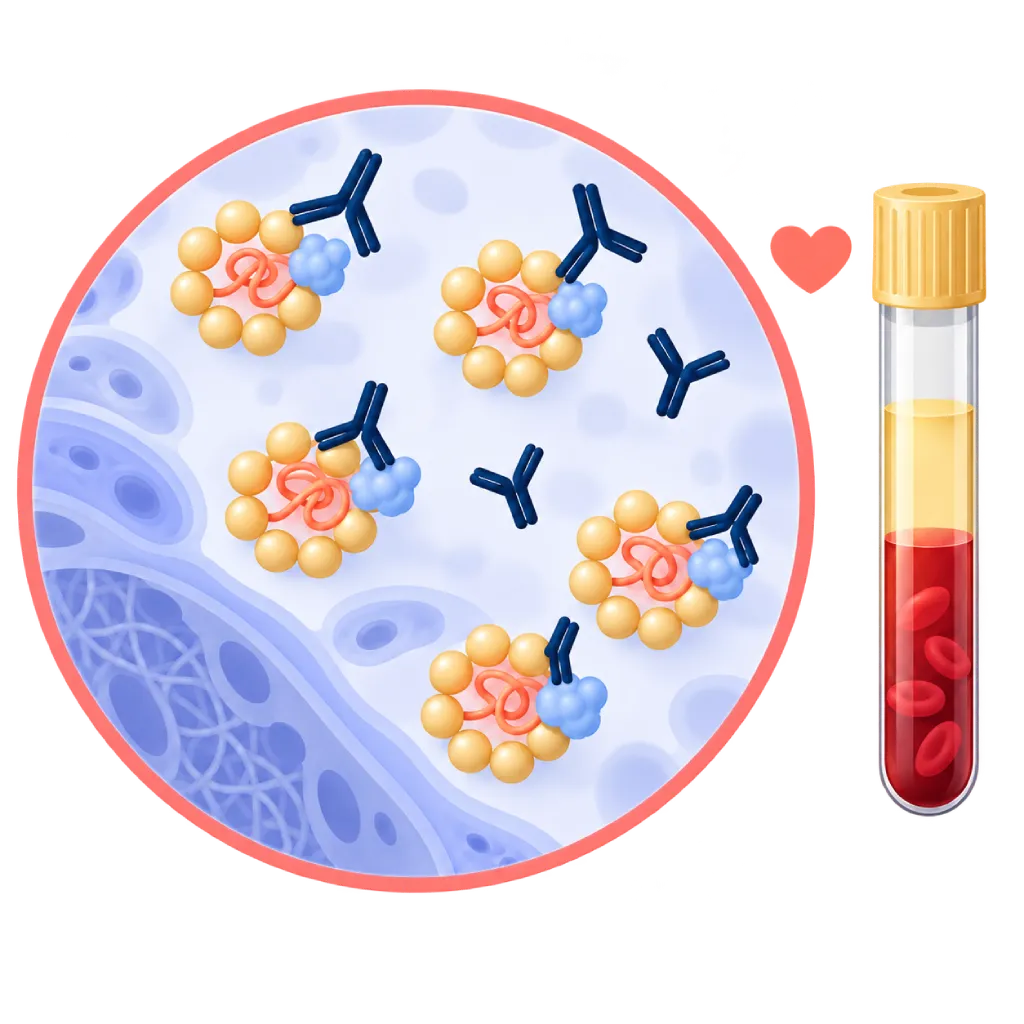
The Sm and RNP proteins sit together in small particles in the cell nucleus. Your serum is reacted with Sm and RNP proteins prepared in the laboratory. If the antibodies are present, they attach to these proteins and are read by the analyzer as a positive result.
Anti-Sm and Anti-RNP
- Anti-Sm: highly specific for lupus. This antibody is found in only some people with lupus, but is rarely found in other diseases, so a positive result strongly supports a diagnosis of lupus.
- Anti-RNP: high levels are a hallmark of mixed connective tissue disease, an autoimmune disease with a combination of symptoms of lupus, scleroderma, and muscle inflammation. Anti-RNP can also be found in lupus and scleroderma.
Reading the Results
- Negative: the antibodies are not found. A negative result does not rule out lupus, because many lupus patients do not have anti-Sm.
- Positive anti-Sm: strongly supports lupus when accompanied by matching symptoms.
- High positive anti-RNP: points to mixed connective tissue disease when accompanied by symptoms such as swollen fingers and fingers that turn pale in the cold.
The levels of these two antibodies do not change much with disease activity, so this test is used for diagnosis, not for routine monitoring.
Anti-Sm/RNP and the Heart
Lupus and mixed connective tissue disease can affect the heart, for example inflammation of the lining around the heart (pericarditis) and inflammation of the heart muscle (myocarditis). Mixed connective tissue disease can also cause pulmonary hypertension, which is high pressure in the blood vessels of the lungs that strains the right side of the heart. For this reason, patients whose results point to these diseases may be advised to have echocardiography to assess the heart and lung pressure.
02 / Understanding the procedure
When Is This Procedure Considered?
A doctor may consider this procedure in the situations below. The decision is always made after a thorough assessment.
- Positive ANA TestTo look for more specific antibodies, especially if the ANA pattern is speckled.
- Suspected LupusSuch as joint pain, rash, recurrent mouth ulcers, or kidney problems.
- Fingers That Turn Pale or Blue in the ColdWith swollen fingers, to look for mixed connective tissue disease.
- Pericarditis or Myocarditis Without a Clear CauseAs part of the search for an autoimmune disease.
- Pulmonary HypertensionTo look for connective tissue disease as its cause.
- Muscle Weakness or Shortness of Breath with Autoimmune SymptomsA combination of symptoms that may point to mixed connective tissue disease.
Situations to Consider First
- ANA Test Not Yet DoneThis test is generally requested after a positive ANA, not as an initial test.
- Used for MonitoringIts levels do not change much with disease activity, so it rarely needs to be repeated.
- Different Laboratory MethodsResults from different laboratories can differ slightly, so they should ideally be compared using the same method.
- Recent Transfusion or PlasmaAntibodies from donor blood can change the results. Tell the staff.
03 / Before the procedure
How Should You Prepare?
The anti-Sm/RNP test uses a blood sample and does not require fasting.
Food and drink. Eat and drink as usual, unless another test done at the same time requires fasting.
Medicines. Take your medicines as usual, including immunosuppressants, unless your doctor asks otherwise. Bring a list of your medicines.
Important information. Tell the staff if you have recently received a transfusion or are pregnant.
Previous results. Bring the results of your ANA test and any other autoimmune tests you have had.
Unsure about the preparation instructions? Ask our team before the procedure.
04 / During the procedure
How Is the Procedure Done?
The blood draw usually takes 10 minutes. Results are usually available within a few days.
Identity Check
The staff match your identity with the test request and ask about the medicines you are taking.
Blood Draw
Blood is drawn from a vein in the crease of your elbow into a serum tube.
Laboratory Analysis
The serum is reacted with Sm and RNP proteins. The analyzer reads whether antibodies attach and how much. This test is often done together with other antibodies in one panel.
Reading the Results
Your doctor reads the results together with your symptoms, physical examination, ANA test, and other tests, because an autoimmune disease is not diagnosed from a single test.
05 / Benefits and risks
Benefits and Risks Should Be Discussed Together.
Every medical procedure has benefits and risks. Your doctor will explain both for your situation before the procedure.
Benefits You Can Expect
- Clarifying a Positive ANA ResultHelps determine the type of underlying autoimmune disease.
- Strongly Supports a Lupus DiagnosisPositive anti-Sm is rarely found in diseases other than lupus.
- Recognizing Mixed Connective Tissue DiseaseHigh levels of anti-RNP are its main hallmark.
- Guiding Heart and Lung TestsResults pointing to this disease prompt earlier testing for pulmonary hypertension.
- Just a Blood SampleNo procedure is needed other than a blood draw.
The benefits of a procedure are not a promise of a cure. Ask how the results will affect your care plan.
Risks You Should Know
- Minor Pain or BruisingAt the needle site, usually mild and quick to go away.
- Brief Dizziness or FaintingSome people feel dizzy when blood is drawn. Tell the staff so you can lie down.
- A Negative Result Does Not Rule Out LupusMany lupus patients do not have anti-Sm, so your doctor still assesses your symptoms and other tests.
- Infection at the Puncture SiteVery rare because the skin is cleaned and the equipment used is sterile and single-use.
Risks can differ from person to person. A full explanation and consent are given after an individual assessment.
06 / After the procedure
What Is Recovery Like?
There is no recovery period. You can return to your activities right away.
Puncture site. A small bruise is normal and goes away within a few days.
If the result is positive. Your doctor completes further tests based on the likely diagnosis, for example an anti-dsDNA test, complement, urine tests, or lung tests.
Heart tests. If you have shortness of breath, chest pain, or palpitations, your doctor may recommend an ECG and echocardiography.
Warning signs to watch for. Go to the emergency room right away or contact the medical team if you experience:
- Sharp chest pain that gets worse when you breathe in or lie down
- Shortness of breath that gets worse, or fainting during activity
- Swelling in both legs with getting tired quickly
- Palpitations with dizziness
Know the Signs That Need Prompt Care.
Follow the team's guidance on warning signs. If severe or sudden symptoms appear after the procedure, go to the nearest emergency department right away or call Heart Attack Center 1500 258.
07 / Team and support
Doctors and Procedure Support
The doctors below are listed for this procedure. Listed by name, not by ranking.

dr. Debby C. Soemitha, Sp.PD
Internal Medicine
Clinical focusDiabetes and Diabetes Complications · Obesity and Metabolic Disease
View Profile
dr. Santi R. Dewayanti, Sp.P
Pulmonology
Clinical focusLung and Respiratory Disease · Asthma and COPD
View Profile
dr. Sri Diniharini, Sp.JP(K)
Echocardiography & Cardiovascular Imaging
Cardiovascular Diagnostic Center +1 center
Clinical focusAdvanced Echocardiography · Transesophageal Echocardiography
View Profile08 / Common questions
Before You Plan the Procedure.
Frequently asked questions about the anti-Sm/RNP test. Your doctor will explain what the results mean for your condition.
What is the difference between the ANA test and the anti-Sm/RNP test?
The ANA test is a screening test that shows whether there are antibodies against the cell nucleus. It can be positive in many autoimmune diseases and in some healthy people. The anti-Sm/RNP test is more specific because it looks for particular antibodies that help your doctor tell lupus apart from mixed connective tissue disease.
Does a positive anti-Sm result mean I definitely have lupus?
Anti-Sm is highly specific for lupus and is rarely found in other diseases. However, lupus is still diagnosed from a combination of symptoms, physical examination, and other test results. Your doctor will assess your symptoms, such as joint pain, rash, or kidney problems, before reaching a diagnosis.
If my anti-Sm result is negative, does that mean I do not have lupus?
Not always. Anti-Sm is found in only some people with lupus, so many lupus patients have a negative result. Your doctor still assesses your symptoms and other tests, such as ANA, anti-dsDNA, complement, and urine tests, to determine whether you have lupus or another autoimmune disease.
What is mixed connective tissue disease?
Mixed connective tissue disease is an autoimmune disease that combines features of lupus, scleroderma, and muscle inflammation. Symptoms include swollen fingers, fingers that turn pale in the cold, joint pain, and muscle weakness. Its main hallmark is a high level of anti-RNP. This disease can affect the lungs and heart.
Does this test need to be repeated regularly?
Usually not. Anti-Sm and anti-RNP levels do not change much with disease activity, so this test is used to help with diagnosis. To monitor lupus activity, doctors usually use other tests such as anti-dsDNA, complement C3 and C4, and urine tests, which are repeated regularly.
How is this test related to the heart?
Lupus and mixed connective tissue disease can cause inflammation of the lining around the heart and of the heart muscle. Mixed connective tissue disease can also cause pulmonary hypertension, which strains the right side of the heart. If your results point to these diseases, your doctor may recommend echocardiography to assess the heart and lung pressure early.
Sources and Medical Review
Translated from the Indonesian edition medically reviewed by dr. Debby C. Soemitha, Sp.PD.
Sources as cited in the Indonesian edition.
- Benito-Garcia E, Schur PH, Lahita R. Guidelines for immunologic laboratory testing in the rheumatic diseases: anti-Sm and anti-RNP antibody tests. Arthritis Rheum. 2004;51(6):1030-1044.
- Agmon-Levin N, Damoiseaux J, Kallenberg C, et al. International recommendations for the assessment of autoantibodies to cellular antigens referred to as anti-nuclear antibodies. Ann Rheum Dis. 2014;73(1):17-23.
- Aringer M, Costenbader K, Daikh D, et al. 2019 European League Against Rheumatism/American College of Rheumatology classification criteria for systemic lupus erythematosus. Arthritis Rheumatol. 2019;71(9):1400-1412.
- Tanaka Y, Kuwana M, Fujii T, et al. 2019 Diagnostic criteria for mixed connective tissue disease (MCTD): from the Japan research committee of the ministry of health, labor, and welfare for systemic autoimmune diseases. Mod Rheumatol. 2021;31(1):29-33.
- Humbert M, Kovacs G, Hoeper MM, et al. 2022 ESC/ERS Guidelines for the diagnosis and treatment of pulmonary hypertension. Eur Heart J. 2022;43(38):3618-3731.
- Fanouriakis A, Kostopoulou M, Andersen J, et al. EULAR recommendations for the management of systemic lupus erythematosus: 2023 update. Ann Rheum Dis. 2024;83(1):15-29.