
Quick answer
What Is Blood Biomarker Tests?
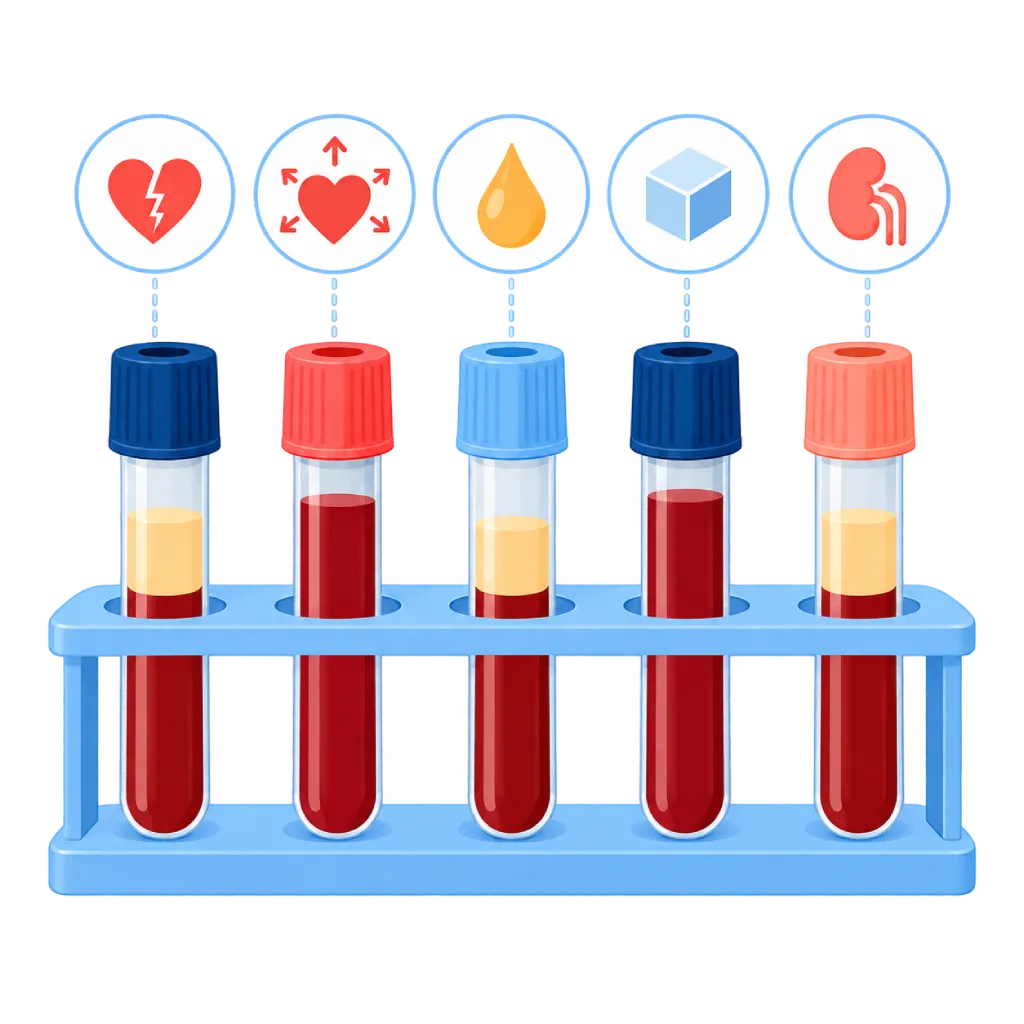
Blood biomarker tests are a set of blood tests that help the doctor assess your heart and its risks. They include markers of heart damage and strain (troponin, NT-proBNP), risk markers (cholesterol, lipoprotein(a), blood sugar), and kidney function tests for medicine safety. Tests are chosen based on your symptoms and the purpose of testing.
Sources01 / Understanding the procedure
About Blood Biomarker Tests
What Are Blood Biomarker Tests
A biomarker is a substance in the blood whose level can be measured and gives clues about the state of the body. In heart care, doctors do not use the same test for everyone. The type of test is chosen according to the purpose: finding the cause of symptoms, assessing the future risk of heart disease, or monitoring the safety of treatment.
How It Works in Brief
Blood is drawn from a vein in your arm and then tested in the laboratory. Some substances are released by the heart itself, for example troponin when heart muscle is damaged and NT-proBNP when the heart chambers are stretched. Other substances, such as cholesterol and sugar, reflect factors that damage the blood vessels over time. The results are read together with your symptoms, physical examination, and ECG, not on their own.
Commonly Checked Test Groups
- Heart muscle damage: cardiac troponin, especially when there is chest pain. This is covered on the Cardiac Troponin Test and Cardiac Biomarkers pages.
- Heart strain: NT-proBNP or BNP when there is shortness of breath and in heart failure. This is covered on the NT-proBNP and BNP Test page.
- Blood vessel risk: a lipid profile (LDL cholesterol, HDL cholesterol, and triglycerides), lipoprotein(a), which is recommended to be checked at least once in a lifetime, and blood sugar or HbA1c. This is covered on the Cholesterol and Lipid Profile Screening and Blood Sugar Test pages.
- Inflammation: hs-CRP to complement risk assessment in some people. This is covered on the C-Reactive Protein (CRP) Test page.
- Kidneys and electrolytes: creatinine, kidney filtration rate (GFR), potassium, and sodium, which are important before and while taking heart medicines. This is covered on the Kidney Function Test and Blood Electrolyte Test pages.
- Supporting tests: a complete blood count to look for anemia, thyroid function in rhythm disorders, and liver function in people taking cholesterol medicines, depending on the situation.
Blood Tests and Prevention
To assess the risk of heart disease, the doctor combines your cholesterol and blood sugar results with your age, blood pressure, and smoking habits. LDL cholesterol targets are set according to your risk level, so the same number can mean something different for two people. If your results are high, the doctor may suggest lifestyle changes or medicines, then repeat the tests to assess the results.
02 / Understanding the procedure
When Is This Procedure Considered?
A doctor may consider this procedure in the situations below. The decision is always made after a thorough assessment.
- Chest Pain or Shortness of BreathTo look for signs of heart damage or heart strain.
- Regular Heart Health CheckupsTo assess cholesterol, blood sugar, and other risk factors.
- Family History of Premature Heart DiseaseIncluding lipoprotein(a) and lipid profile testing.
- Diabetes, Hypertension, or Kidney DiseaseTo assess the risk and the effects on the heart.
- Monitoring Heart MedicinesSuch as cholesterol medicines, blood thinners, diuretics, or medicines that affect potassium.
- Before a Procedure or SurgeryTo assess kidney function, complete blood count, and blood clotting.
Situations to Consider First
- Not Fasting When Fasting Is RequiredSome tests, such as fasting blood sugar, require fasting for 8 to 10 hours.
- Recent Strenuous Exercise or Current IllnessSome levels can change temporarily; let the staff know.
- Taking High-Dose Biotin SupplementsThese can interfere with the results of some laboratory tests, including troponin.
- Fear of Needles or Fainting EasilyTell the staff so your blood can be drawn while you lie down.
03 / Before the procedure
How Should You Prepare?
Preparation depends on the type of test your doctor requests.
Fasting. A lipid profile generally does not require fasting. Fasting for 8 to 10 hours is usually requested for fasting blood sugar, or if your triglycerides were previously very high. You may still drink plain water.
Medicines and supplements. Keep taking your regular medicines unless told otherwise. Bring a list of your medicines and supplements, including biotin.
Timing of the blood draw. If you are monitoring a particular medicine, ask whether your blood should be drawn before or after taking the medicine.
Clothing. Wear clothes with loose sleeves that are easy to roll up.
Unsure about the preparation instructions? Ask our team before the procedure.
04 / During the procedure
How Is the Procedure Done?
The blood draw usually takes about 10 minutes. How long the results take depends on the type of test, from less than one hour for urgent tests such as troponin to several days for certain tests.
Identity Check and Preparation
The staff match your identity with the doctor's request and ask whether you have fasted, if fasting is needed.
Blood Draw
A band is tied around your upper arm briefly, the skin is cleaned, then blood is drawn from a vein with a fine needle into several tubes according to the type of test.
Laboratory Testing
Each tube is processed with the appropriate equipment. When a heart attack is suspected, troponin is usually repeated after 1 to 3 hours to see how it changes.
Reading the Results
The doctor reads the results together with your symptoms and other tests, then explains the next steps.
05 / Benefits and risks
Benefits and Risks Should Be Discussed Together.
Every medical procedure has benefits and risks. Your doctor will explain both for your situation before the procedure.
Benefits You Can Expect
- One Blood Draw for Many TestsSeveral tubes can be collected at once.
- Helping Find the Cause of SymptomsSuch as heart damage or heart strain.
- Assessing Risk Before Symptoms AppearCholesterol, lipoprotein(a), and blood sugar.
- Monitoring Medicine SafetyKidney function, potassium, and liver function.
- Quick and Nearly Risk-FreeOnly a small amount of blood from the arm is needed.
The benefits of a procedure are not a promise of a cure. Ask how the results will affect your care plan.
Risks You Should Know
- Bruising or Pain at the Puncture SiteMild and goes away on its own.
- Dizziness or FaintingRare; tell the staff if you faint easily.
- The Blood Draw May Need to Be RepeatedIf the sample is insufficient or compromised, for example if the blood clots in the tube.
- Out-of-Range Results Without DiseaseA single number does not always mean you are ill; the doctor assesses the overall picture.
Risks can differ from person to person. A full explanation and consent are given after an individual assessment.
06 / After the procedure
What Is Recovery Like?
There is no recovery period. Press on the puncture site for a few minutes to prevent bruising. You can return to your activities right away, and you may eat if you were fasting.
Mild bruising. This is normal and goes away within a few days.
Warning signs. Go to the emergency room right away if, while waiting for your results, you experience:
- Severe or persistent chest pain
- Shortness of breath that gets worse
- Fainting or a very fast heartbeat
- Swelling, pain, or redness that spreads at the puncture site
Know the Signs That Need Prompt Care.
Follow the team's guidance on warning signs. If severe or sudden symptoms appear after the procedure, go to the nearest emergency department right away or call Heart Attack Center 1500 258.
07 / Team and support
Doctors and Procedure Support
The doctors below are listed for this procedure. Listed by name, not by ranking.

dr. Debby C. Soemitha, Sp.PD
Internal Medicine
Clinical focusDiabetes and Diabetes Complications · Obesity and Metabolic Disease
View Profile
Dr. med. dr. Denio A. Ridjab, Sp.JP(K)
Interventional Cardiology
Coronary Intervention Procedures +2 centers
Clinical focusInterventional Cardiology · Coronary Artery Disease
View Profile
dr. Siska S. Danny, Sp.JP(K)
Interventional Cardiology
Coronary Intervention Procedures
Clinical focusPCI for Acute Coronary Syndrome · Primary Coronary Intervention
View Profile08 / Common questions
Before You Plan the Procedure.
Frequently asked questions about blood biomarker tests. Your doctor will explain what the results mean for your condition.
Which blood tests are usually done during a heart checkup?
It depends on the purpose. To assess risk, the doctor usually requests a lipid profile, blood sugar or HbA1c, kidney function, and electrolytes, sometimes with a complete blood count. Troponin and NT-proBNP are generally checked when there are symptoms such as chest pain or shortness of breath. The doctor will choose the tests that are actually needed, not every test at once.
Do I have to fast before a blood test?
Not always. A lipid profile can now generally be checked without fasting, which is more practical. Fasting for 8 to 10 hours is usually requested for fasting blood sugar, or if your triglycerides were previously very high. If you are unsure, ask the staff when you make your appointment. You may still drink plain water while fasting.
What is lipoprotein(a) and why is it checked?
Lipoprotein(a) is a type of blood fat whose level is largely determined by genetics. A high level adds to the risk of heart attack, stroke, and narrowing of the aortic valve. Because its level barely changes throughout life, guidelines recommend checking it at least once. If it is high, the doctor will control your other risk factors more strictly.
Does one high result mean I have heart disease?
Not necessarily. Blood levels can be affected by food, exercise, infection, medicines, or how the sample was taken. The doctor reads the results together with your symptoms, physical examination, and other tests, and sometimes asks for a repeat test. Discuss your results with your doctor before drawing your own conclusions or changing your medicines.
How often do blood tests need to be repeated?
It depends on your situation. After starting or changing a cholesterol medicine, the lipid profile is usually rechecked after about 6 to 8 weeks, then periodically. Certain medicines, such as those that affect potassium, require kidney and electrolyte tests a few weeks after they are started. Your doctor will set the right schedule.
Can supplements affect test results?
Yes. High-dose biotin, which is often found in hair and nail supplements, can cause incorrect results in some laboratory tests, including troponin and thyroid hormones. Tell the staff about all the supplements you take. The doctor may ask you to pause certain supplements for a few days before the test.
Sources and Medical Review
Translated from the Indonesian edition medically reviewed by dr. Siska S. Danny, Sp.JP(K).
Sources as cited in the Indonesian edition.
- Visseren FLJ, Mach F, Smulders YM, et al. 2021 ESC Guidelines on cardiovascular disease prevention in clinical practice. Eur Heart J. 2021;42(34):3227-3337.
- Mach F, Baigent C, Catapano AL, et al. 2019 ESC/EAS Guidelines for the management of dyslipidaemias: lipid modification to reduce cardiovascular risk. Eur Heart J. 2020;41(1):111-188.
- Mach F, Koskinas KC, Roeters van Lennep JE, et al. 2025 Focused Update of the 2019 ESC/EAS Guidelines for the management of dyslipidaemias. Eur Heart J. 2025;46(42):4359-4378.
- Nordestgaard BG, Langsted A, Mora S, et al. Fasting is not routinely required for determination of a lipid profile: clinical and laboratory implications including flagging at desirable concentration cut-points. Eur Heart J. 2016;37(25):1944-1958.
- Byrne RA, Rossello X, Coughlan JJ, et al. 2023 ESC Guidelines for the management of acute coronary syndromes. Eur Heart J. 2023;44(38):3720-3826.
- McDonagh TA, Metra M, Adamo M, et al. 2021 ESC Guidelines for the diagnosis and treatment of acute and chronic heart failure. Eur Heart J. 2021;42(36):3599-3726.