
Quick answer
What Is Rheumatoid Arthritis?
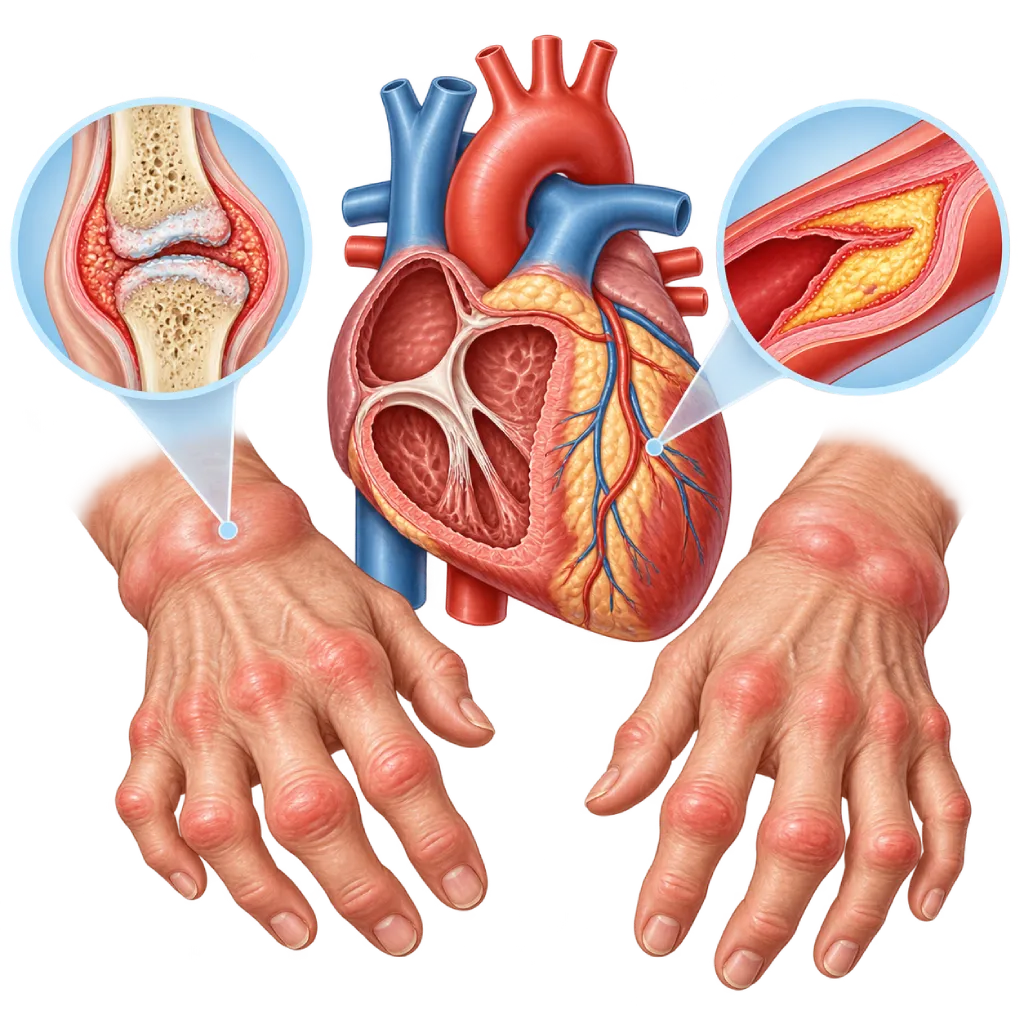
Rheumatoid arthritis is a long-term autoimmune disease that makes joints painful, swollen, and stiff, especially the small joints of the hands and feet. The inflammation also affects blood vessels, so the risk of heart disease and stroke goes up.
SourcesSigns That Need Urgent Help
- Chest pain or pressure lasting more than a few minutes
- Severe shortness of breath or being unable to lie flat
- Weakness on one side of the body, a drooping face, or slurred speech
- Sharp chest pain that gets worse when you breathe in or lie down
- One swollen, painful leg along with sudden shortness of breath
- High fever or chills while taking medicines that suppress the immune system
If these signs appear, go to the nearest emergency department right away or call Heart Attack Center 1500 258.
01 / Understanding the condition
About Rheumatoid Arthritis
Rheumatoid arthritis is a long-term autoimmune disease, a condition in which the immune system mistakenly attacks the body's own tissues. Its main target is the inner lining of the joints (synovium), so the joints become painful, swollen, warm, and stiff. The small joints of the fingers, wrists, and toes are often affected, usually on both sides of the body at the same time. Morning joint stiffness that lasts more than 30 minutes is a typical feature. Without treatment, the inflammation can damage cartilage and bone, changing the shape of the joints.
Not Just a Joint Disease
The inflammation in rheumatoid arthritis affects the whole body and can involve the lungs, eyes, skin, blood vessels, and heart. People with rheumatoid arthritis have a risk of dying from heart and blood vessel disease about 1.5 times higher than people their age. That is why protecting the heart is part of managing this disease, not just relieving joint pain.
Effects on the Heart
Long-term inflammation speeds up the buildup of plaque in blood vessel walls (atherosclerosis), raising the risk of heart attack and stroke. Heart attack symptoms in people with rheumatoid arthritis are sometimes atypical, or may not be felt at all. The risk of heart failure is also higher, often with a stiff heart muscle even though its pumping strength looks normal. Inflammation of the sac around the heart (pericarditis) is fairly often found on echocardiography, although it rarely causes symptoms. Less often, the disease affects the heart muscle, valves, or the heart's electrical system. Common risk factors, such as smoking, high blood pressure, and lack of physical activity, add to this burden, as do some medicines when used for a long time, such as corticosteroids and nonsteroidal anti-inflammatory drugs.
Treatment That Also Protects the Heart
Controlling inflammation as early as possible benefits the joints and is also thought to lower heart risk. EULAR guidelines recommend a cardiovascular risk assessment at diagnosis and at least every five years, along with control of blood pressure, cholesterol, and smoking, as in the general population. Care for rheumatoid arthritis involves an internal medicine specialist or a rheumatologist, together with a cardiologist when needed. Coronary heart disease is covered on the Coronary Artery Disease page.
02 / Understanding the condition
Symptoms to Recognize.
Common Symptoms
- Pain, swelling, and warmth in several joints, often on both sides of the body
- Small joints of the fingers, wrists, and toes are affected
- Morning joint stiffness lasting more than 30 minutes
- Tiredness, low-grade fever, or loss of appetite
- Firm lumps under the skin, for example near the elbow
- Difficulty gripping objects or buttoning clothes
- Dry eyes and dry mouth
Symptoms in Older Adults
When the disease starts later in life, its pattern can differ and resemble other diseases, so it is easily recognized late.
- A more sudden onset, sometimes in large joints such as the shoulders
- Stiffness and pain in the shoulders and hips
- Weakness, low-grade fever, or weight loss
- Reduced ability to carry out daily activities
03 / Understanding the condition
What Causes This Condition?
- The immune system mistakenly attacks the joint lining (synovium), making it inflamed and thickened
- Antibodies such as rheumatoid factor and anti-CCP, which can appear years before symptoms
- Certain inherited genes, especially the HLA-DRB1 gene group
- Environmental triggers, especially smoking, which interact with inherited genes
- Long-term inflammation that also affects the blood vessels, heart, lungs, and other organs
04 / Understanding the condition
Who Is at Higher Risk?
Genetic
A family history of rheumatoid arthritis and certain inherited genes, especially the HLA-DRB1 group, increase the chance of developing it. Most people who carry these genes still never develop the disease.
Lifestyle
Smoking increases the risk of rheumatoid arthritis, especially the type with anti-CCP antibodies, and makes the disease more severe. Obesity is also linked to a higher risk.
Age
The disease can appear at any age, but it usually starts between the ages of 30 and 60.
Medical
For effects on the heart, the risk increases with high blood pressure, high cholesterol, diabetes, disease that has been active for a long time, or long-term corticosteroid use.
Other
Women are affected two to three times more often. Long-term gum disease and exposure to silica dust are also linked to a higher risk.
Groups at Higher Risk
- Women Aged 30 to 60: Women are two to three times more likely to develop rheumatoid arthritis, which usually begins during their working years.
- Smokers: Smoking increases the risk of rheumatoid arthritis, especially the type with anti-CCP antibodies, and also raises the risk of heart attack in people who have the disease.
- People with Rheumatoid Arthritis and Heart Risk Factors: High blood pressure, high cholesterol, diabetes, or disease that has been active for a long time add to the risk of heart attack and stroke, so regular assessment and control are needed.
- Family Members of People with Rheumatoid Arthritis: Close relatives are more likely to develop the disease. Learn the early symptoms and get checked if joint pain and swelling persist.
05 / Understanding the condition
How Is It Diagnosed?
No single test can confirm rheumatoid arthritis. Your doctor asks about the pattern of pain, how long the symptoms have lasted, and morning stiffness, then examines the painful and swollen joints. Blood tests look for rheumatoid factor and anti-CCP antibodies, as well as markers of inflammation such as CRP and the erythrocyte sedimentation rate. X-rays or ultrasound of the joints assess inflammation and damage. Doctors use the 2010 ACR/EULAR classification criteria, which combine the number of affected joints, antibody results, inflammation markers, and symptom duration of six weeks or more. After diagnosis, heart risk is assessed by measuring blood pressure, cholesterol, and blood sugar, preferably when the disease is quiet. If there are symptoms such as shortness of breath, chest pain, or palpitations, an ECG and echocardiography help look for coronary disease, heart failure, or fluid in the sac around the heart.
Physical Examination
Counting tender and swollen joints, looking for lumps under the skin, listening to the heart and lungs, and measuring blood pressure.
Blood tests for rheumatoid factor and anti-CCP antibodies. Anti-CCP is more specific to rheumatoid arthritis, but a negative result does not rule out the disease.
C-Reactive Protein (CRP) Test
Measures a marker of inflammation to help with diagnosis and to monitor disease activity during treatment.
Erythrocyte Sedimentation Rate (ESR)
Another marker of inflammation, used together with CRP to assess disease activity.
X-rays or ultrasound of the hands and feet to assess inflammation and joint damage, including as a baseline for comparison at follow-up visits.
Cholesterol and Lipid Profile Screening
Part of the heart risk assessment. It should preferably be measured when the disease is quiet, because active inflammation can make cholesterol levels look lower.
Echocardiography
Done if there is shortness of breath, chest pain, or swelling, to assess how well the heart pumps and to look for fluid in the sac around the heart.
06 / Understanding the condition
Treatment Options.
Treatment is decided by a doctor after an assessment. The categories below can help you follow the conversation with your doctor.
Conventional DMARDs
Disease-modifying medicines, such as methotrexate, are started as early as possible to suppress inflammation and prevent joint damage. Regular blood tests are needed while you take them. The type and dose are decided by your doctor.
Biologic and Targeted Synthetic DMARDs
Used when the treatment target has not been reached. JAK inhibitors are considered with caution in people aged 65 and over, smokers, or people at high heart risk, based on findings from the ORAL Surveillance study.
Short-Term Corticosteroids
Help relieve inflammation at the start of treatment or during a flare, then are tapered and stopped as soon as possible, because long-term use raises blood pressure, blood sugar, and heart risk.
Nonsteroidal Anti-Inflammatory Drugs
Relieve pain and stiffness but do not stop joint damage. Their use is limited and supervised by a doctor, especially if you have heart disease, high blood pressure, or kidney problems.
Heart Risk Control
Blood pressure, cholesterol, and blood sugar are controlled as in the general population, including statins or blood pressure medicines when needed, along with quitting smoking.
Physical Exercise and Rehabilitation
Aerobic and muscle-strengthening exercise suited to your ability, along with physiotherapy or occupational therapy, helps maintain joint function, fitness, and heart health.
07 / Understanding the condition
Complications to Watch For.
Coronary Artery Disease
Long-term inflammation speeds up plaque buildup in the coronary arteries. The risk of heart attack is higher, and its symptoms are sometimes atypical.
Heart Failure
The risk of heart failure is higher than in people of the same age, often with a stiff heart muscle. Symptoms include shortness of breath, tiring easily, and swollen legs.
Pericarditis
Inflammation of the sac around the heart can cause fluid to build up around the heart. It often causes no symptoms, but sometimes leads to sharp chest pain or shortness of breath.
Stroke and Blood Clots
The risk of stroke, atrial fibrillation, and blood clots in the veins is higher, especially when the disease is active.
Permanent Joint Damage
Uncontrolled inflammation damages cartilage and bone, changing the shape of the joints and reducing the function of the hands or feet.
Interstitial Lung Disease
Inflammation and scarring in the lung tissue can cause a dry cough and shortness of breath that slowly get worse.
Osteoporosis
Inflammation, lack of movement, and long-term corticosteroid use can reduce bone density, so bones break more easily.
08 / Understanding the condition
What Can You Do?
- Quit smoking, to lower the risk of rheumatoid arthritis as well as the risk of heart attack
- Take your disease-controlling medicines regularly and attend follow-up visits as scheduled
- Ask for a heart risk assessment at diagnosis and repeat it at least every five years
- Have your blood pressure, cholesterol, and blood sugar checked regularly
- Stay active with aerobic and strengthening exercise suited to your ability
- Maintain a healthy weight and a balanced, nutritious diet
- Do not use pain relievers or corticosteroids long term without a doctor's supervision
- Take care of your teeth and gums regularly
09 / Understanding the condition
When Should You See a Doctor?
See a doctor if joint pain and swelling last more than a few weeks, because treatment started early helps prevent joint damage. If you have already been diagnosed, also tell your doctor about any heart symptoms. Go to the emergency room right away if chest pain lasts more than a few minutes or signs of stroke appear.
- Pain and swelling in several joints of the hands or feet for more than six weeks
- Morning joint stiffness lasting more than 30 minutes
- Shortness of breath during activity or when lying down, or swollen legs
- Chest pain, especially if it is sharp and changes with position or breathing
- Irregular palpitations or unusual tiredness
- A dry cough and shortness of breath that keep getting worse
Don't Wait in an Emergency.
If symptoms are severe or come on suddenly, go to the nearest emergency department right away or call Heart Attack Center 1500 258, rather than waiting for an appointment.
10 / Common questions
Questions You May Have.
Frequently asked questions about rheumatoid arthritis and its effects on the heart.
Why does rheumatoid arthritis increase the risk of heart disease?
The inflammation that occurs in the joints also takes place in the blood vessels. Inflammatory substances damage the inner lining of the vessels and speed up plaque formation, raising the risk of heart attack and stroke. Common risk factors, such as smoking and high blood pressure, along with some medicines used for a long time, add to the risk. That is why controlling both inflammation and heart risk factors matters.
Do people with rheumatoid arthritis need to take cholesterol medicine?
Not everyone does. The decision is based on a heart risk assessment, just as for other people, but EULAR guidelines recommend assessing that risk while counting rheumatoid arthritis as a factor that adds to it. Cholesterol should preferably be measured when the disease is quiet, because active inflammation can make levels look lower. If your risk is high, your doctor may recommend a statin.
Do rheumatoid arthritis medicines affect the heart?
Some do. Corticosteroids and nonsteroidal anti-inflammatory drugs used for a long time can raise blood pressure and heart risk, so they are used for as short a time as possible. JAK inhibitors are considered with caution in people at high heart risk. On the other hand, controlling inflammation with medicines such as methotrexate has been linked to lower heart risk in observational studies. Do not stop any medicine without talking to your doctor.
Is rheumatoid arthritis the same as gout or osteoarthritis?
No. Gout is caused by a buildup of crystals and usually affects one joint suddenly. Osteoarthritis happens when cartilage wears down, especially in the knees and hips. Rheumatoid arthritis is an autoimmune disease that usually affects many small joints on both sides of the body. All three are also different from rheumatic heart disease, which is covered on the Rheumatic Heart Disease page.
Can rheumatoid arthritis be cured?
Rheumatoid arthritis is a long-term disease that cannot yet be cured, but it can be controlled. With treatment started early and adjusted regularly, many people reach remission or low disease activity, so pain eases and joint damage can be prevented. Regular follow-up is still needed even after symptoms improve, because the disease can flare up again.
What kinds of exercise are safe for people with rheumatoid arthritis?
Moderate-intensity aerobic exercise, such as walking, stationary cycling, or swimming, plus muscle-strengthening and flexibility exercises, is generally safe and good for both the joints and the heart. When a joint is inflamed, choose gentle movements that do not put heavy loads on that joint. A physiotherapist can help you design a program that suits the condition of your joints.
Sources and Medical Review
Translated from the Indonesian edition medically reviewed by dr. Debby C. Soemitha, Sp.PD.
Sources as cited in the Indonesian edition.
- Agca R, Heslinga SC, Rollefstad S, Heslinga M, McInnes IB, Peters MJ, et al. EULAR recommendations for cardiovascular disease risk management in patients with rheumatoid arthritis and other forms of inflammatory joint disorders: 2015/2016 update. Ann Rheum Dis. 2017;76(1):17-28.
- Smolen JS, Landewé RBM, Bergstra SA, Kerschbaumer A, Sepriano A, Aletaha D, et al. EULAR recommendations for the management of rheumatoid arthritis with synthetic and biological disease-modifying antirheumatic drugs: 2022 update. Ann Rheum Dis. 2023;82(1):3-18.
- Aletaha D, Neogi T, Silman AJ, Funovits J, Felson DT, Bingham CO 3rd, et al. 2010 Rheumatoid arthritis classification criteria: an American College of Rheumatology/European League Against Rheumatism collaborative initiative. Arthritis Rheum. 2010;62(9):2569-81.
- Smolen JS, Aletaha D, McInnes IB. Rheumatoid arthritis. Lancet. 2016;388(10055):2023-38.
- Ytterberg SR, Bhatt DL, Mikuls TR, Koch GG, Fleischmann R, Rivas JL, et al. Cardiovascular and cancer risk with tofacitinib in rheumatoid arthritis. N Engl J Med. 2022;386(4):316-26.
- Avina-Zubieta JA, Choi HK, Sadatsafavi M, Etminan M, Esdaile JM, Lacaille D. Risk of cardiovascular mortality in patients with rheumatoid arthritis: a meta-analysis of observational studies. Arthritis Rheum. 2008;59(12):1690-7.
Doctors Who Treat This Condition

dr. Debby C. Soemitha, Sp.PD
Internal Medicine
Clinical focusDiabetes and Diabetes Complications · Obesity and Metabolic Disease
View Profile
Dr. med. dr. Denio A. Ridjab, Sp.JP(K)
Interventional Cardiology
Coronary Intervention Procedures +2 centers
Clinical focusInterventional Cardiology · Coronary Artery Disease
View Profile
dr. Ayu Amalia U. Putri, Sp.KFR
Physical Medicine & Rehabilitation
Clinical focusCardiac Rehabilitation · Postoperative Rehabilitation
View Profile