
Quick answer
What Is Embolectomy?
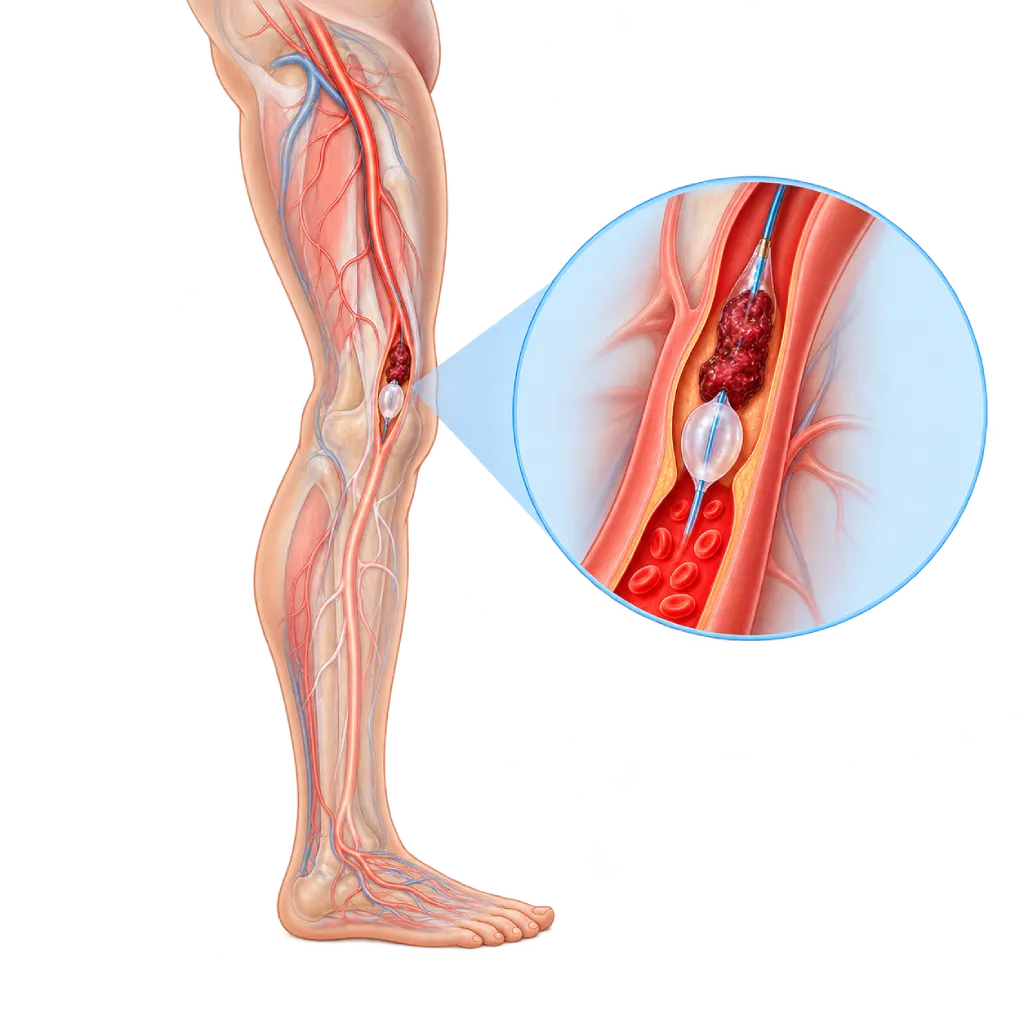
Embolectomy is an emergency procedure to remove an embolus, a blood clot that traveled through the bloodstream and blocked an artery, mainly in the leg or arm. The doctor inserts a balloon catheter through a small incision and pulls the clot out. The procedure takes about 1 to 3 hours and must be done without delay.
Sources01 / Understanding the procedure
About Embolectomy
What Is Embolectomy
An embolus is a blood clot, or sometimes other material, that breaks loose and travels in the bloodstream until it gets stuck in a smaller vessel. These clots usually come from the heart, for example in atrial fibrillation or after a heart attack. When a clot blocks an artery in the leg or arm, the tissue beyond it suddenly lacks blood. Embolectomy is a procedure to remove that blockage so blood flow is restored.
How It Works at a Glance
For a blocked leg artery, the doctor makes a small incision in the groin or behind the knee and opens a small section of the artery wall. A thin catheter with a balloon at its tip is pushed past the clot, the balloon is inflated, then the catheter is slowly pulled back so the clot comes out with it. This step is repeated until blood flows freely again, then the artery and skin are stitched closed.
Why It Must Be Done Quickly
Muscles and nerves can only tolerate a lack of blood for a limited time, usually a few hours. The sooner blood flow is restored, the greater the chance that the leg or arm can be saved. For this reason, sudden pain with a leg that is pale, cold, tingling, or hard to move needs to be taken to the emergency room right away.
Other Catheter-Based Options
In some patients, the clot can be removed or dissolved through a catheter without an incision, for example with a suction device or clot-dissolving medication. This is covered on the Thrombectomy page. If the blockage occurs on top of a long-standing narrowing, the doctor may add balloon widening or bypass surgery, covered on the Peripheral Bypass Surgery page.
Pulmonary Embolectomy
In severe, life-threatening pulmonary embolism, the clot in the pulmonary arteries can be removed with heart surgery. This procedure is considered when clot-dissolving medication cannot be given or has not worked, and it is performed by the cardiac surgery team under general anesthesia.
After Embolectomy
Blood thinners are given to prevent new clots, covered on the Anticoagulation Therapy and Stroke Prevention page. The doctor also looks for the source of the clot, for example with heart rhythm recording and echocardiography.
02 / Understanding the procedure
When Is This Procedure Considered?
A doctor may consider this procedure in the situations below. The decision is always made after a thorough assessment.
- Sudden Blockage of a Leg ArteryThe leg suddenly becomes painful, pale, cold, or tingly.
- Sudden Blockage of an Arm ArteryThe arm or hand suddenly becomes painful, pale, and weak.
- Emboli from the HeartFor example, in atrial fibrillation or after a heart attack.
- Severe Pulmonary EmbolismWhen clot-dissolving medication cannot be given or has not worked.
- Clots from an Arterial AneurysmFor example, from a widened artery behind the knee.
Situations to Consider First
- Tissue Can No Longer Be SavedMuscles and nerves are severely damaged; other treatment such as amputation is considered.
- Very Poor General ConditionThe risks of the procedure and the options are discussed with the patient and family.
- Blockage Due to Long-Standing NarrowingBetter suited to catheter-based treatment or bypass.
- Mild Lack of Blood FlowTreatment may begin with medication and further tests.
03 / Before the procedure
How Should You Prepare?
Embolectomy is usually an emergency procedure, so preparation is done quickly in the emergency room or on the ward.
Blood thinners. These are usually given right away through an IV to keep the clot from spreading.
Rapid tests. A pulse check with Doppler, blood tests, and an ECG. If time allows, CT angiography or angiography is done to locate the blockage, covered on the Peripheral Angiography page.
Information from family. Share the medications being taken, especially blood thinners, any history of heart disease or irregular heartbeat, allergies, and the time of the last meal.
Consent. The doctor explains the treatment options, their risks, and the possibility of additional procedures.
Unsure about the preparation instructions? Ask our team before the procedure.
04 / During the procedure
How Is the Procedure Done?
Leg artery embolectomy takes about 1 to 3 hours in the operating room, under local anesthesia with sedation or under general anesthesia. Pulmonary embolectomy requires heart surgery under general anesthesia and takes longer.
Opening the Artery
The doctor makes a small incision in the groin or behind the knee, then opens a small section of the artery wall.
Pulling Out the Clot
A balloon catheter is pushed past the clot, the balloon is inflated, then the catheter is slowly pulled back so the clot comes out. This step is repeated for each blocked branch.
Confirming Blood Flow
Blood flow is checked by feeling the pulse, with Doppler, or with angiography during the procedure. If there is a narrowing, a balloon, stent, or bypass may be added.
Closing the Wound
The artery and skin are stitched closed. If the leg muscles become very swollen after blood flow returns, the doctor may make pressure-relieving incisions in the calf (fasciotomy).
05 / Benefits and risks
Benefits and Risks Should Be Discussed Together.
Every medical procedure has benefits and risks. Your doctor will explain both for your situation before the procedure.
Benefits You Can Expect
- Rapid Restoration of Blood FlowThe clot is removed directly from the blocked artery.
- The Leg or Arm Can Be SavedEspecially when the procedure is done early, within a few hours.
- Small IncisionLeg arteries are usually reached through the groin or behind the knee.
- An Option When Clot-Dissolving Medication Cannot Be GivenFor example, because of a high bleeding risk or recent surgery.
The benefits of a procedure are not a promise of a cure. Ask how the results will affect your care plan.
Risks You Should Know
- Bleeding or Bruising at the WoundMore likely because of blood thinners; monitored by the team.
- Muscle Swelling After Blood Flow ReturnsIt can compress muscles and nerves, so pressure-relieving incisions may be needed.
- Repeat BlockageClots can form again, which is why blood thinners and monitoring are important.
- Kidney ProblemsCaused by substances released from damaged muscle or by contrast; kidney function is checked.
- Wound InfectionRare; prevented with good wound care.
- Limb LossIf the tissue is already severely damaged before blood flow is restored.
Risks can differ from person to person. A full explanation and consent are given after an individual assessment.
06 / After the procedure
What Is Recovery Like?
Patients stay in the hospital for several days. The length of stay depends on the condition of the leg and the underlying disease that was the source of the clot.
Monitoring the leg. The color, temperature, pulse, sensation, and movement of the leg are checked regularly, especially within 24 hours of the procedure.
Blood thinners. These are continued as your doctor advises. In atrial fibrillation, they are usually taken long term.
Finding the source of the clot. Your doctor may arrange heart rhythm recording, echocardiography, or blood vessel tests.
Wound and activity. Keep the wound clean and dry. Start walking gradually as the team instructs.
Warning signs. Go to the emergency room right away if you have:
- Pain, paleness, coldness, or tingling returning in the leg or arm
- A very swollen, hard, and painful calf
- Bleeding or growing swelling at the wound
- A drooping face, weakness on one side of the body, or slurred speech
- Sudden shortness of breath or chest pain
Know the Signs That Need Prompt Care.
Follow the team's guidance on warning signs. If severe or sudden symptoms appear after the procedure, go to the nearest emergency department right away or call Heart Attack Center 1500 258.
07 / Team and support
Doctors and Procedure Support
The doctors below are listed for this procedure. Listed by name, not by ranking.

Dr. dr. Dudy A. Hanafy, Sp.BTKV, Subsp. JD(K), MARS
Adult Cardiac Surgery
Advanced Cardiovascular Surgical Care +1 center
Clinical focusMinimally Invasive Cardiac Surgery · Coronary Artery Bypass Surgery
View Profile
dr. Emanoel Oepangat, Sp.JP(K)
Interventional Cardiology
Vascular Diagnostic and Therapeutic Center +1 center
Clinical focusCoronary Intervention · Peripheral Vascular Intervention
View Profile
dr. Suko Adiarto, Sp.JP(K), Ph.D.
Interventional Cardiology
Vascular Diagnostic and Therapeutic Center +1 center
Clinical focusCoronary Intervention · Peripheral Vascular Intervention
View Profile08 / Common questions
Before You Plan the Procedure.
Frequently asked questions about embolectomy. In an emergency, contact the emergency room right away.
What are the signs of a sudden leg artery blockage?
The signs appear suddenly: severe pain, a pale or bluish leg that feels cold, tingling or numbness, and difficulty moving the leg. The pulse in the foot usually cannot be felt. This is an emergency. Go to the emergency room or call emergency services right away, and do not wait for symptoms to improve, because muscles can be damaged within a few hours.
Where does the blood clot come from?
It usually comes from the heart, for example in atrial fibrillation, after a heart attack, or in valve disease. Clots can also come from a widened artery, for example behind the knee, or from plaque in the aorta. After the procedure, the doctor looks for the source with heart rhythm recording, echocardiography, and blood vessel tests so that a similar event can be prevented.
What is the difference between embolectomy and thrombectomy?
Both remove blood clots. Embolectomy removes a clot that has traveled from elsewhere, usually with a balloon catheter through a small incision. Thrombectomy removes a clot that formed at that spot, often through a catheter without an incision, for example with a suction device. The doctor chooses the appropriate method based on the location, the type of clot, and the patient's condition.
Will I need to take blood thinners afterward?
Usually, yes. Blood thinners prevent new clots from forming and causing another blockage. If the source is atrial fibrillation, these medications are usually taken long term. The type and duration are decided by your doctor based on the source of the clot and your bleeding risk. Do not stop the medication without consulting your doctor.
Can the leg fully recover?
Many patients recover well if blood flow is restored quickly. If the blockage lasts a long time, some muscle or nerve tissue may be damaged, leaving weakness, numbness, or pain. In very severe cases, it may not be possible to save the leg. Exercise and physiotherapy help recovery after going home.
When is pulmonary embolectomy performed?
Pulmonary embolectomy is considered in severe pulmonary embolism with a drop in blood pressure or shock, when clot-dissolving medication cannot be given because of bleeding risk or has not worked. It involves heart surgery under general anesthesia, followed by intensive care. In some patients, the clot can be treated through a catheter.
Sources and Medical Review
Translated from the Indonesian edition medically reviewed by dr. Emanoel Oepangat, Sp.JP(K).
Sources as cited in the Indonesian edition.
- Björck M, Earnshaw JJ, Acosta S, et al. European Society for Vascular Surgery (ESVS) 2020 Clinical Practice Guidelines on the Management of Acute Limb Ischaemia. Eur J Vasc Endovasc Surg. 2020;59(2):173-218.
- Mazzolai L, Teixido-Tura G, Lanzi S, et al. 2024 ESC Guidelines for the management of peripheral arterial and aortic diseases. Eur Heart J. 2024;45(36):3538-3700.
- Gornik HL, Aronow HD, Goodney PP, et al. 2024 ACC/AHA/AACVPR/APMA/ABC/SCAI/SVM/SVN/SVS/SIR/VESS Guideline for the Management of Lower Extremity Peripheral Artery Disease. Circulation. 2024;149(24):e1313-e1410.
- Konstantinides SV, Meyer G, Becattini C, et al. 2019 ESC Guidelines for the diagnosis and management of acute pulmonary embolism developed in collaboration with the European Respiratory Society (ERS). Eur Heart J. 2020;41(4):543-603.
- Van Gelder IC, Rienstra M, Bunting KV, et al. 2024 ESC Guidelines for the management of atrial fibrillation developed in collaboration with the European Association for Cardio-Thoracic Surgery (EACTS). Eur Heart J. 2024;45(36):3314-3414.
- Kalra R, Bajaj NS, Arora P, et al. Surgical embolectomy for acute pulmonary embolism: systematic review and comprehensive meta-analyses. Ann Thorac Surg. 2017;103(3):982-990.