
Quick answer
What Is Atrial Tachycardia?
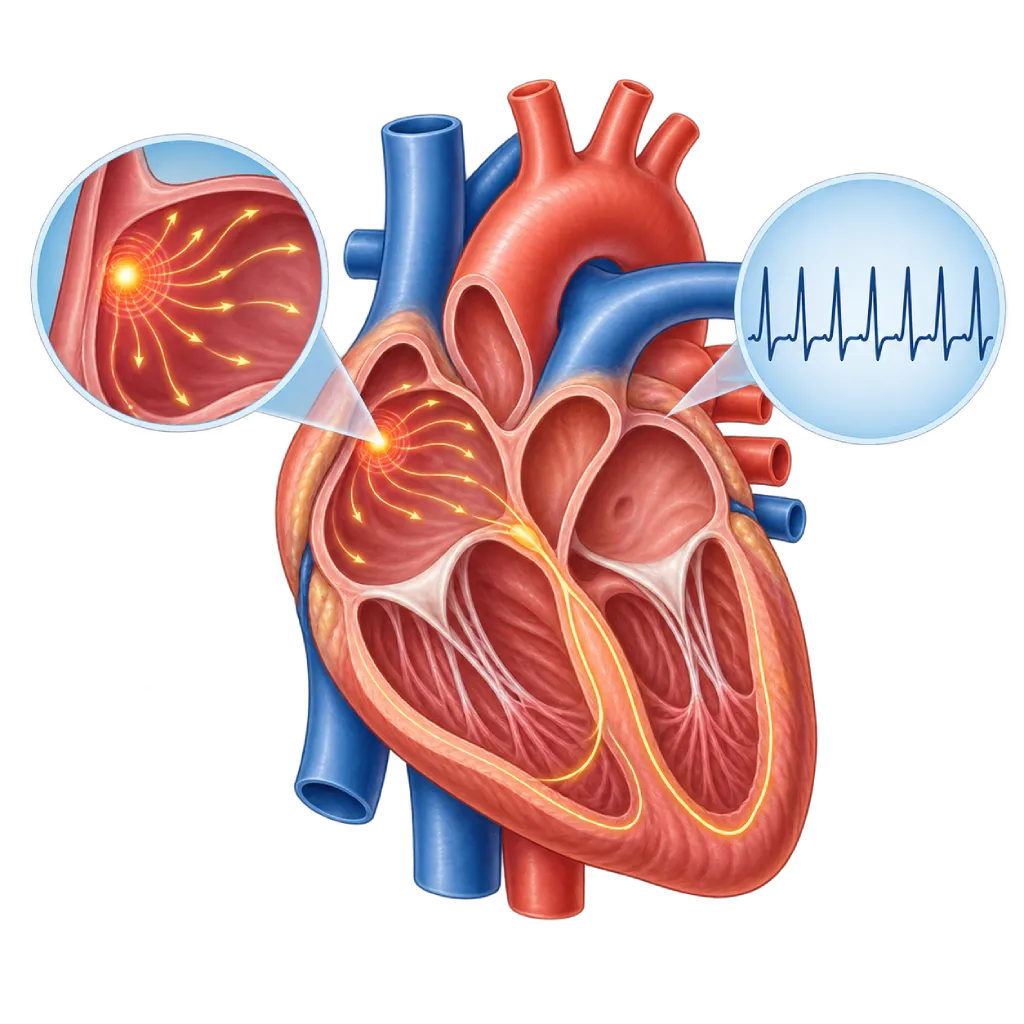
Atrial tachycardia is a fast heart rate triggered by one or more spots in the upper chambers (atria), not by the heart's natural pacemaker. It can come and go or continue nonstop, and it can be treated with medicines or ablation.
SourcesSigns That Need Urgent Help
- Fainting or nearly losing consciousness
- Severe chest pain
- Severe shortness of breath, or shortness of breath when lying down
- A fast heartbeat with cold sweat, pale skin, and severe weakness
- Leg swelling and shortness of breath that get worse quickly
If these signs appear, go to the nearest emergency department right away or call Heart Attack Center 1500 258.
01 / Understanding the condition
About Atrial Tachycardia
Atrial tachycardia is one type of supraventricular tachycardia. Normally, each heartbeat starts in the sinus node, the heart's natural pacemaker in the right atrium. In atrial tachycardia, another spot in the atria (the upper chambers of the heart) sends signals faster and takes over the rhythm. The heart rate is usually 100 to 250 beats per minute. These signals still pass to the ventricles through the normal pathway, so the heartbeat is usually regular and is felt as a rapid pounding.
Types of Atrial Tachycardia
A frequently seen type is focal atrial tachycardia, in which fast signals come from a single spot, for example near the openings of the pulmonary veins or around the tricuspid valve. Multifocal atrial tachycardia comes from several spots at once, so the rhythm is irregular; this type often accompanies severe lung disease in older adults. There is also atrial tachycardia caused by signals circling around scar tissue, usually after heart surgery or ablation for atrial fibrillation. This form is similar to the one covered on the Atrial Flutter page.
Coming and Going or Continuous
Some people have episodes that come and go. An episode often starts with a heartbeat that gradually speeds up, then slows down before it stops. In others, especially children and teenagers, atrial tachycardia can continue almost all day. Because it comes to feel normal over time, it sometimes goes unnoticed until tiredness, shortness of breath, or swelling appears. A fast heart rate that persists for weeks can weaken the heart muscle, a condition called tachycardia-induced cardiomyopathy. Pumping function usually recovers once the rhythm is controlled.
Triggers and Treatment
Atrial tachycardia can occur in a healthy heart, but it more often accompanies heart disease, lung disease, or previous heart surgery. Low potassium levels, an overactive thyroid, caffeine, alcohol, and some medicines can trigger it. Treatment starts by addressing the triggers, followed by medicines that control the heart rate. If episodes keep coming back or continue nonstop, catheter ablation can deactivate the trigger spot. In multifocal atrial tachycardia, the main treatment is improving the lung disease and oxygen levels. A general overview of fast heart rates is covered on the Tachycardia page.
02 / Understanding the condition
Symptoms to Recognize.
Common Symptoms
- A fast, pounding heartbeat, sometimes starting slowly and then speeding up
- Weakness and tiring quickly
- Dizziness or a lightheaded feeling
- Shortness of breath during activity
- Chest discomfort
- No symptoms, with the fast heart rate only found during a checkup
Symptoms in Children
In children, atrial tachycardia more often continues nonstop, so the signs are tiredness and a reduced ability to be active.
- Tiring easily and not able to play as usual
- Fast breathing or shortness of breath during activity
- Reduced appetite
- A fast pulse found during a health checkup
- A bloated abdomen or swollen legs if the heart's pumping weakens
03 / Understanding the condition
What Causes This Condition?
- A spot in the atria that sends signals faster than the sinus node
- Signals circling around scar tissue after heart surgery or ablation
- Chronic lung disease or low blood oxygen levels
- Enlarged atria due to valve disease, hypertension, or heart failure
- Low blood potassium or magnesium levels
- An overactive thyroid gland, caffeine, alcohol, or stimulants
- Excess levels of the medicine digoxin in the blood
04 / Understanding the condition
Who Is at Higher Risk?
Lifestyle
Too much caffeine, energy drinks, alcohol, smoking, and stimulants can trigger episodes in susceptible people.
Medical
Chronic obstructive pulmonary disease, valve disease, heart failure, coronary artery disease, hypertension, and thyroid disorders make the atria more prone to electrical problems.
Age
Focal atrial tachycardia can appear in childhood, while the multifocal type and the type linked to scar tissue are found more often in adults and older adults.
Other
Previous heart surgery, including surgery for congenital heart disease, and previous ablation for atrial fibrillation leave scar tissue that can become a pathway for circling signals.
Groups at Higher Risk
- People with Chronic Lung Disease: Chronic obstructive pulmonary disease and low oxygen levels are linked to multifocal atrial tachycardia, especially during a flare-up of the lung disease.
- People Who Have Had Heart Surgery or Ablation: Scar tissue in the atria can become a pathway for circling signals, so tachycardia can appear years after the procedure.
- Children and Teenagers: Focal atrial tachycardia at a young age more often continues nonstop and can weaken the heart muscle if it is not recognized.
- People with Valve Disease or Heart Failure: Enlarged, stretched atria are more likely to develop spots that trigger fast signals.
05 / Understanding the condition
How Is It Diagnosed?
Your doctor starts by asking about your symptoms, the medicines you take, and any history of heart or lung disease. An ECG taken during tachycardia shows a fast rhythm with P waves, the waves from the atria, that have a different shape from normal sinus rhythm. The shape of these waves gives a clue to the location of the trigger spot. If episodes come and go, a Holter monitor or long-term recorder helps capture an episode and measure how long the tachycardia lasts each day.
Echocardiography assesses the size of the atria, the valves, and pumping strength, especially if the tachycardia has been going on for a long time. Blood tests check potassium, magnesium, thyroid function, and, if needed, medicine levels. If ablation is being considered, an electrophysiology study maps the location of the trigger spot or circling signal pathway from inside the heart with the help of a three-dimensional map.
Electrocardiogram (ECG)
Shows a fast rhythm with P waves shaped differently from the normal rhythm, while also giving a clue to the location of the trigger spot.
Holter Monitoring
Records the rhythm for 24 to 48 hours to see how often and how long the tachycardia occurs.
Echocardiography
Assesses the size of the atria, the valves, and pumping strength, which is important if the tachycardia has been going on for a long time.
Blood Electrolyte Test
Checks potassium and magnesium, which can trigger atrial tachycardia when they are low.
Thyroid Function Test
Looks for an overactive thyroid gland as a trigger of the fast heart rate.
Electrophysiology Study
Maps the location of the trigger spot or circling signal pathway in the atria as the basis for ablation.
06 / Understanding the condition
Treatment Options.
Treatment is decided by a doctor after an assessment. The categories below can help you follow the conversation with your doctor.
Addressing Triggers
Your doctor corrects potassium and magnesium levels, treats lung or thyroid disease, and reviews medicines that may be triggers.
Rate and Rhythm Control Medicines
Beta blockers or calcium channel blockers slow the heart rate or stop an episode. Other antiarrhythmic medicines are used in certain situations, and your doctor decides which type.
Electrical Cardioversion
A controlled electric shock under brief sedation if an episode comes with a drop in blood pressure. In some focal types, this method is less successful, so other methods are chosen.
Catheter Ablation
The trigger spot or circling signal pathway is deactivated through a catheter. Guidelines recommend ablation for recurrent atrial tachycardia, especially if it is continuous or has already weakened the heart.
07 / Understanding the condition
Complications to Watch For.
Tachycardia-Induced Cardiomyopathy
Tachycardia that continues for weeks can weaken the heart muscle. Pumping function usually recovers within a few months after the rhythm is controlled.
Heart Failure
In a heart that is already weak or in severe lung disease, a fast heart rate can trigger shortness of breath, swelling, and hospitalization.
Fainting and Injury
Episodes with a very fast heart rate can lower blood pressure, leading to fainting and injuries from falls, although this is rare.
08 / Understanding the condition
What Can You Do?
- Limit caffeine, energy drinks, and alcohol if they trigger symptoms
- Quit smoking, especially if you also have lung disease
- Keep lung disease, blood pressure, and thyroid conditions under control as your doctor advises
- Take your medicines on schedule and report side effects to your doctor
- Repeat the ECG and echocardiogram at your scheduled checkups if tachycardia occurs often
- Have a child who seems to tire easily and has a fast pulse checked promptly
09 / Understanding the condition
When Should You See a Doctor?
Atrial tachycardia often does not cause severe symptoms, but a fast heart rate that keeps coming back or does not go away still needs to be checked. Early evaluation helps find the trigger and prevent the heart muscle from weakening. Go to the emergency room right away if danger signs appear.
- A fast heartbeat that often comes back or lasts for hours
- A resting pulse that stays above 100 beats per minute without a clear cause
- Tiredness, shortness of breath, or leg swelling that becomes more noticeable
- A child who seems to tire easily and has a fast pulse
- Fainting, severe chest pain, or severe shortness of breath: go to the emergency room right away
Don't Wait in an Emergency.
If symptoms are severe or come on suddenly, go to the nearest emergency department right away or call Heart Attack Center 1500 258, rather than waiting for an appointment.
10 / Common questions
Questions You May Have.
Common questions about atrial tachycardia.
What is the difference between atrial tachycardia and atrial fibrillation?
Both start in the atria. In atrial tachycardia, signals come from a single spot or a single regular pathway, so the heartbeat is usually fast and regular. In atrial fibrillation, the signals in the atria are chaotic, so the heartbeat is irregular. This difference matters because the stroke risk and treatment are different. Atrial fibrillation is covered on the Atrial Fibrillation page.
Is atrial tachycardia dangerous?
It is usually not life-threatening. However, tachycardia that continues nonstop for weeks can weaken the heart muscle. This is often not noticed because the symptoms are just tiredness or shortness of breath. That is why a persistent fast heart rate needs to be checked. If it is found and treated, heart function usually recovers.
Can ablation get rid of atrial tachycardia?
In many patients, ablation can deactivate the trigger spot so the tachycardia does not come back. The result depends on the location and number of trigger spots. Types that come from many spots, such as multifocal atrial tachycardia in lung disease, are usually better managed by treating the lung disease. Your doctor will explain the chances and risks before the procedure.
Why can atrial tachycardia appear after heart surgery or ablation?
Heart surgery and ablation leave scar tissue in the atria. In some people, electrical signals can circle around that scar tissue and cause tachycardia, sometimes years later. This does not mean the earlier procedure failed. This type of tachycardia can usually be mapped and treated with ablation.
Can children have atrial tachycardia?
Yes. In children and teenagers, focal atrial tachycardia tends to continue nonstop. A child may not complain of a pounding heart but may seem to tire easily, be less active, or breathe fast. If it is not recognized, the heart muscle can weaken. An ECG and echocardiography by a pediatric cardiologist help determine the right treatment, including medicines or ablation.
Sources and Medical Review
Translated from the Indonesian edition medically reviewed by Dr. dr. Faris Basalamah, Sp.JP(K).
Sources as cited in the Indonesian edition.
- Brugada J, Katritsis DG, Arbelo E, et al. 2019 ESC Guidelines for the management of patients with supraventricular tachycardia. The Task Force for the management of patients with supraventricular tachycardia of the European Society of Cardiology (ESC). Eur Heart J. 2020;41(5):655-720.
- Katritsis DG, Boriani G, Cosio FG, et al. European Heart Rhythm Association (EHRA) consensus document on the management of supraventricular arrhythmias, endorsed by Heart Rhythm Society (HRS), Asia-Pacific Heart Rhythm Society (APHRS), and Sociedad Latinoamericana de Estimulacion Cardiaca y Electrofisiologia (SOLAECE). Europace. 2017;19(3):465-511.
- Page RL, Joglar JA, Caldwell MA, et al. 2015 ACC/AHA/HRS Guideline for the Management of Adult Patients With Supraventricular Tachycardia. Circulation. 2016;133(14):e506-e574.
- Medi C, Kalman JM, Haqqani H, et al. Tachycardia-mediated cardiomyopathy secondary to focal atrial tachycardia: long-term outcome after catheter ablation. J Am Coll Cardiol. 2009;53(19):1791-1797.
- Huizar JF, Ellenbogen KA, Tan AY, Kaszala K. Arrhythmia-Induced Cardiomyopathy: JACC State-of-the-Art Review. J Am Coll Cardiol. 2019;73(18):2328-2344.
Doctors Who Treat This Condition

dr. Sunu B. Raharjo, Sp.JP(K), Ph.D.
Arrhythmia and Electrophysiology
Arrhythmia and Device Center
Clinical focusClinical and Interventional Electrophysiology · Cardiac Arrhythmia Ablation
View Profile
Dr. dr. Dicky A. Hanafy, Sp.JP(K)
Arrhythmia and Electrophysiology
Arrhythmia and Device Center +1 center
Clinical focusElectrophysiology and Arrhythmia Ablation · Pacemaker and ICD Implantation
View Profile
Dr. dr. Faris Basalamah, Sp.JP(K)
Interventional Cardiology
Coronary Intervention Procedures +1 center
Clinical focusComplex Coronary Intervention · Cardiac Electrophysiology
View Profile