
Quick answer
What Is Urinalysis?
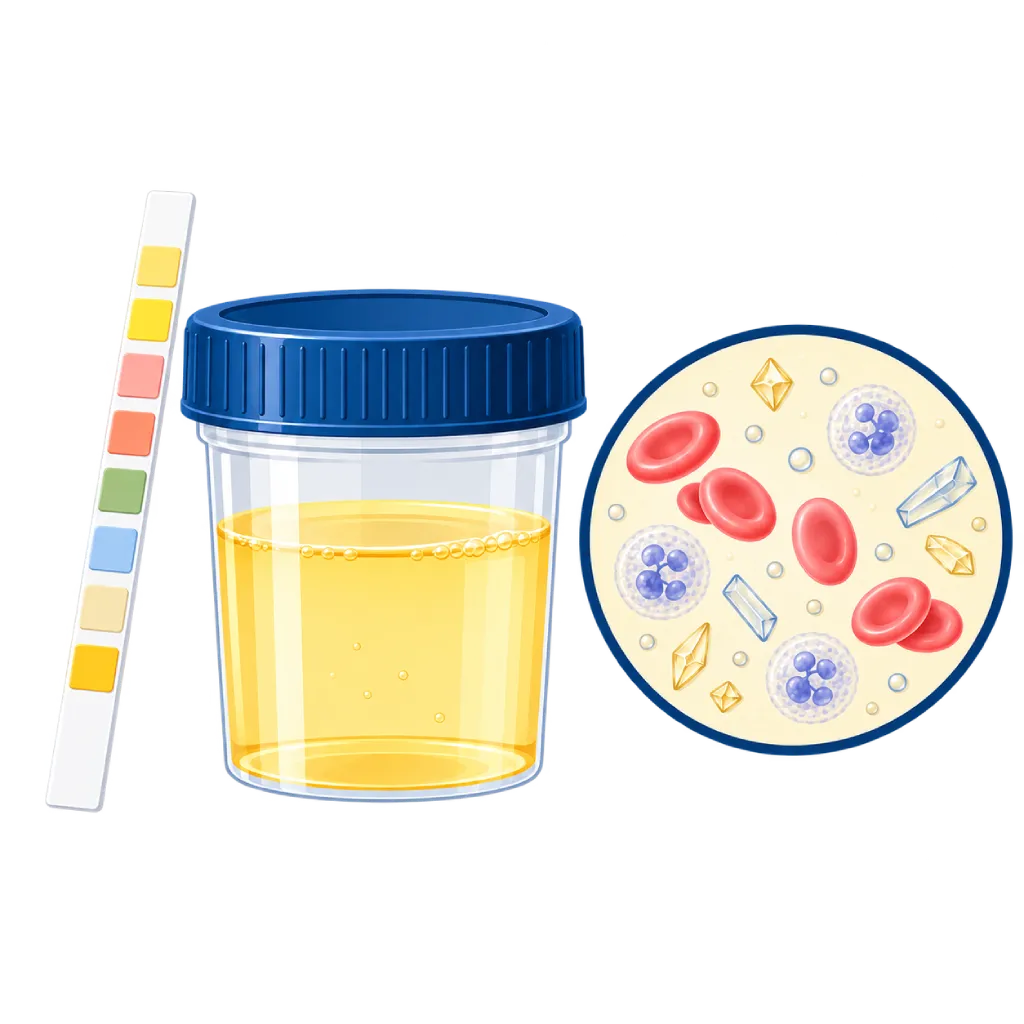
Urinalysis, also called a complete urine test, examines a urine sample in three ways: its physical appearance, its chemical content using a dipstick, and cells or particles under a microscope. The results help detect urinary tract infections, kidney problems, sugar or protein in the urine, and blood that needs further investigation, including in heart patients.
Sources01 / Understanding the procedure
About Urinalysis
What Is Urinalysis
Urinalysis, or a complete urine test, is a simple test that provides a lot of information about the kidneys, the urinary tract, and your general health. It is often part of a routine health checkup, the initial evaluation of high blood pressure, and preparation for a procedure or surgery.
How It Works in Brief
The urine sample is examined in three stages. To begin, its color and clarity are assessed. Next, a dipstick with several chemical pads is dipped into the urine, and the color changes show the levels of various substances. Finally, the urine sediment is examined under a microscope to look for cells and particles.
What Is Examined
- Physical: color, clarity, and specific gravity, which reflects how concentrated the urine is.
- Chemical: acidity (pH), protein, glucose, ketones, blood, bilirubin, urobilinogen, nitrite, and leukocyte esterase.
- Microscopic: red blood cells, white blood cells, epithelial cells, casts, crystals, and bacteria.
Reading the Results
Positive nitrite and white blood cells often indicate a urinary tract infection. Protein indicates leakage from the kidneys, and red blood cell casts can indicate inflammation of the kidney filters. Blood in the urine needs to have its cause investigated. Blood that is positive on the dipstick without red blood cells under the microscope can come from muscle damage. Results are always read together with symptoms and other tests.
Urine and the Heart
In high blood pressure and diabetes, urinalysis helps detect kidney damage, which also signals heart risk. SGLT2 inhibitors, used for heart failure and diabetes, make urine glucose positive as part of how the medicine works. Blood in the urine of people taking blood thinners still needs to have its cause investigated. In endocarditis, urine may show blood or protein due to kidney inflammation.
02 / Understanding the procedure
When Is This Procedure Considered?
A doctor may consider this procedure in the situations below. The decision is always made after a thorough assessment.
- Urinary SymptomsPain or discomfort when urinating, a constant urge to urinate, or frequent urination.
- Initial Evaluation of High Blood PressureTo look for kidney damage and certain causes of hypertension.
- DiabetesHelps assess sugar, ketones, and protein in the urine.
- Preparation for Surgery or a Heart Device ImplantTo find a urinary tract infection that needs to be treated beforehand.
- Reddish or Foamy UrineTo look for blood or protein in the urine.
- Routine Health CheckupPart of a health checkup package for early detection.
Situations to Consider First
- MenstruationMenstrual blood can contaminate the sample. Postpone the test until your period is over.
- Strenuous ExerciseCan cause temporary protein or blood in the urine.
- Taking SGLT2 InhibitorsPositive urine glucose is an effect of the medicine and does not mean your diabetes is getting worse.
- Overly Diluted UrineDrinking too much before the test can make the results look falsely normal.
- Samples Stored Too LongBacteria can multiply and cells can break down, so the sample should be tested promptly.
03 / Before the procedure
How Should You Prepare?
Urinalysis only requires one urine sample.
Collection time. Early morning urine is often recommended, but a random urine sample can also be used as instructed.
Eating and drinking. No fasting is needed. Drink as usual and avoid drinking excessively just before the test.
Menstruation. If you are menstruating, postpone the test until your period is over if possible.
Medicines. Bring a list of your medicines, especially SGLT2 inhibitors, diuretics, antibiotics, and high-dose vitamins.
Activity. Avoid strenuous exercise the day before.
Unsure about the preparation instructions? Ask our team before the procedure.
04 / During the procedure
How Is the Procedure Done?
Collecting the urine only takes a few minutes, and results are usually available on the same day.
Instructions and Container
The staff gives you a sterile container labeled with your name and explains how to collect the urine.
Cleaning the Genital Area
Wash your hands, then clean the genital area with the tissue or cotton provided so the sample is not contaminated.
Collecting Midstream Urine
Let a small amount of urine flow into the toilet at the start, collect the middle portion of the stream in the container, then finish urinating in the toilet. Close the container tightly and hand it to the staff.
Testing in the Laboratory
The staff assesses the appearance of the urine, dips the dipstick into it, then spins part of the urine in a centrifuge to examine the sediment under a microscope.
05 / Benefits and risks
Benefits and Risks Should Be Discussed Together.
Every medical procedure has benefits and risks. Your doctor will explain both for your situation before the procedure.
Benefits You Can Expect
- Simple and PainlessOnly a urine sample is needed, with no needles.
- Lots of Information from One SampleAssesses the kidneys, urinary tract, sugar, and signs of other diseases at the same time.
- Detecting Infection EarlierImportant before surgery or a heart device implant.
- Helping Assess Kidney and Heart RiskProtein in the urine is a clue to kidney damage in hypertension and diabetes.
- Quick ResultsUsually available on the same day.
The benefits of a procedure are not a promise of a cure. Ask how the results will affect your care plan.
Risks You Should Know
- No Physical RiskThe test only uses urine, with no needles or medicines.
- Contaminated SampleIncorrect collection can mean the test needs to be repeated.
- False-Positive or False-Negative ResultsMedicines, vitamins, diluted urine, or a sample tested late can affect the results.
- Further Testing May Be NeededFindings such as blood or protein are usually confirmed with other tests.
Risks can differ from person to person. A full explanation and consent are given after an individual assessment.
06 / After the procedure
What Is Recovery Like?
There is no recovery period. You can return to your activities right away.
If there is an infection. Your doctor may prescribe antibiotics, sometimes after a urine culture to confirm the bacteria causing it.
If there is blood or protein. The test is usually repeated and supplemented with kidney function tests, a urine protein ratio, or an ultrasound.
Before a heart procedure. A urinary tract infection is usually treated before surgery or a device implant.
Warning signs. Contact the medical team if you have:
- Fever with flank pain or chills
- Dark red urine or urine with blood clots
- Inability to urinate or a sharp drop in urine output
- Worsening swelling with very foamy urine
Know the Signs That Need Prompt Care.
Follow the team's guidance on warning signs. If severe or sudden symptoms appear after the procedure, go to the nearest emergency department right away or call Heart Attack Center 1500 258.
07 / Team and support
Doctors and Procedure Support
The doctors below are listed for this procedure. Listed by name, not by ranking.

dr. Debby C. Soemitha, Sp.PD
Internal Medicine
Clinical focusDiabetes and Diabetes Complications · Obesity and Metabolic Disease
View Profile
dr. Khaira U. Yusrie, Sp.PD-KGEH
Gastroenterology & Hepatology
Clinical focusInternal Medicine · Gastroenterology and Hepatology
View Profile
dr. Siska S. Danny, Sp.JP(K)
Interventional Cardiology
Coronary Intervention Procedures
Clinical focusPCI for Acute Coronary Syndrome · Primary Coronary Intervention
View Profile08 / Common questions
Before You Plan the Procedure.
Frequently asked questions about urinalysis. What the results mean for your condition is explained by your doctor.
What does urinalysis check?
Urinalysis has three parts. The physical examination assesses color, clarity, and specific gravity. The chemical examination with a dipstick assesses pH, protein, glucose, ketones, blood, bilirubin, nitrite, and leukocyte esterase. The microscopic examination looks at blood cells, epithelial cells, casts, crystals, and bacteria.
Why is my urine glucose positive when my blood sugar is under control?
If you take an SGLT2 inhibitor, such as dapagliflozin or empagliflozin, positive urine glucose is expected. These medicines work by removing sugar through the urine and are used for diabetes, heart failure, and kidney disease. Tell your doctor and the staff that you take this medicine.
Is blood in the urine dangerous?
Blood in the urine can be caused by infection, urinary stones, strenuous exercise, menstruation, or kidney disease, and sometimes by a more serious condition. For this reason, the cause of blood in the urine needs to be investigated, including in people taking blood thinners. Your doctor may order a repeat test or kidney tests, or refer you to a urologist.
What is the difference between urinalysis and a urine protein test?
Urinalysis gives a general picture of many substances at once, including a rough estimate of protein with a dipstick. Urine protein tests such as UACR or UPCR measure protein more precisely. If the dipstick shows protein, your doctor usually follows up with a urine protein test to find out how much protein there is.
Do I need to fast before a urine test?
No. You can eat and drink as usual, but avoid drinking too much just before the test, because diluted urine can make the results less accurate. Early morning urine is often recommended because it is more concentrated. If you are menstruating, it is better to postpone the test until your period is over.
Why is a urine test requested before a heart procedure?
An undetected urinary tract infection can spread and increase the risk of infection after heart surgery or the implantation of devices such as pacemakers and artificial valves. A urine test helps find an infection early so it can be treated before the procedure, while also assessing the condition of your kidneys.
Sources and Medical Review
Translated from the Indonesian edition medically reviewed by dr. Debby C. Soemitha, Sp.PD.
Sources as cited in the Indonesian edition.
- Kavuru V, Vu T, Karageorge L, et al. Dipstick analysis of urine chemistry: benefits and limitations of dry chemistry-based assays. Postgrad Med. 2020;132(3):225-233.
- Mancia G, Kreutz R, Brunström M, et al. 2023 ESH Guidelines for the management of arterial hypertension. J Hypertens. 2023;41(12):1874-2071.
- Barocas DA, Boorjian SA, Alvarez RD, et al. Microhematuria: AUA/SUFU Guideline. J Urol. 2020;204(4):778-786.
- Delgado V, Ajmone Marsan N, de Waha S, et al. 2023 ESC Guidelines for the management of endocarditis. Eur Heart J. 2023;44(39):3948-4042.
- Kidney Disease: Improving Global Outcomes (KDIGO) CKD Work Group. KDIGO 2024 Clinical Practice Guideline for the Evaluation and Management of Chronic Kidney Disease. Kidney Int. 2024;105(4S):S117-S314.