
Quick answer
What Is Urine Tests?
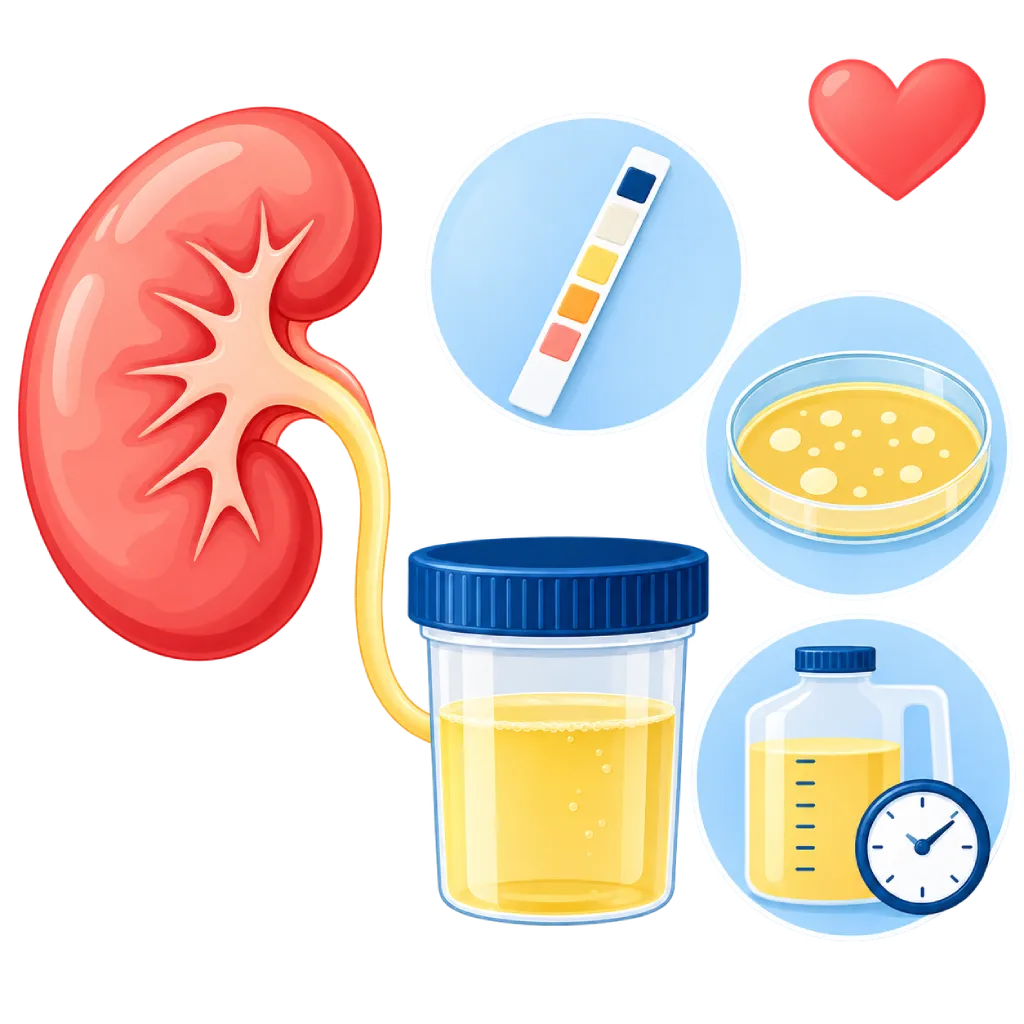
Urine testing is a general term for various tests that use a urine sample, including a complete urinalysis, urine protein, urine sodium, urine culture, and hormones in a 24-hour urine collection. In heart patients, urine tests help assess the kidneys, look for causes of high blood pressure, and adjust the dose of diuretic medication.
Sources01 / Understanding the procedure
About Urine Tests
What Are Urine Tests
The kidneys filter the blood and remove waste products, excess salt, and fluid through the urine. For this reason, urine can reflect the condition of the kidneys, blood sugar, infection, certain hormones, and the body's fluid balance. Urine testing is a general term for various tests on a urine sample, and the doctor chooses the type based on the question that needs to be answered.
How It Works in Brief
The majority of tests use a spot urine sample collected within a few minutes in a sterile container, usually a midstream sample. Some tests require all the urine collected over 24 hours. The laboratory then examines its physical properties, chemicals, cells, germs, or hormones, depending on the type of test requested.
Types of Urine Tests Commonly Used in Heart Patients
- Urinalysis: color, clarity, dipstick, and microscopic examination. This is covered on the Urinalysis page.
- Urine protein: UACR for albumin and UPCR for total protein, markers of kidney damage and heart risk. These are covered on the Urine Protein Test and Urine Protein-to-Creatinine Ratio (UPCR) pages.
- Urine sodium: in heart failure, assesses how much salt is removed after diuretic medication.
- Urine culture: looks for germs that cause urinary tract infections, for example before heart surgery or device implantation.
- 24-hour urine metanephrines: looks for a tumor of the adrenal gland (pheochromocytoma) that can cause high blood pressure.
- Urine pregnancy test: before tests or procedures involving radiation or certain medications in women of childbearing age.
Urine Tests and the Heart
In hypertension, urine testing is recommended from the start to look for kidney damage and clues to the cause of high blood pressure. In heart failure, urine sodium checked a few hours after a diuretic helps the doctor assess whether the dose is sufficient. High urine protein indicates a greater risk of heart attack, stroke, and heart failure, so risk factors need to be controlled more tightly.
02 / Understanding the procedure
When Is This Procedure Considered?
A doctor may consider this procedure in the situations below. The decision is always made after a thorough assessment.
- Initial Hypertension EvaluationLooks for kidney damage and clues to the cause of high blood pressure.
- Hard-to-Control HypertensionLooks for causes such as kidney disease or pheochromocytoma.
- Heart Failure Treated with DiureticsAssesses the response to medication and monitors kidney function.
- Diabetes or Kidney DiseaseRegular testing to detect protein leakage early.
- Fever or Symptoms When UrinatingLooks for a urinary tract infection and the germ causing it.
- Before Heart Surgery or a ProcedureConfirms there is no urinary tract infection, plus a pregnancy test if needed.
Situations to Consider First
- During MenstruationBlood can contaminate the sample. Postpone the test if possible.
- Incorrect Collection MethodGerms from the skin can contaminate the sample, especially for urine culture.
- Already Taking AntibioticsThe urine culture may appear negative. The sample should ideally be taken before antibiotics.
- Strenuous Exercise or FeverCan temporarily raise urine protein.
- Incomplete 24-Hour Urine CollectionMissing even one urination makes the result too low.
- Certain Medications or FoodsCan affect urine hormone tests. Follow the staff's instructions before collecting.
03 / Before the procedure
How Should You Prepare?
Preparation depends on the type of urine test requested. The staff will give you a container and written instructions.
Spot urine sample. An early morning urine sample is usually used, or one as instructed by your doctor. No fasting is needed, and you can drink as usual.
24-hour urine. When you wake up in the morning, empty your bladder into the toilet and note the time. After that, collect all your urine until the same time the next day, and keep the container in a cool place.
Urine culture. If possible, the sample is taken before you start taking antibiotics.
Medications. Bring a list of your medications. Do not stop diuretics or blood pressure medications unless your doctor tells you to.
Important information. Tell the staff if you are menstruating, pregnant, or have a fever or symptoms when urinating.
Unsure about the preparation instructions? Ask our team before the procedure.
04 / During the procedure
How Is the Procedure Done?
Collecting a spot urine sample takes only a few minutes. If your doctor requests a 24-hour urine collection, it is done at home over one full day.
Instructions and Container
The staff give you a container labeled with your name for the type of test and explain how to collect the urine.
Collecting a Midstream Urine Sample
Wash your hands, clean the genital area, let a little urine flow into the toilet at the start, then collect the middle portion of the urine in the container and close it tightly.
24-Hour Urine Collection
If requested, all urine over 24 hours is collected in the large container provided, then brought back to the laboratory.
Laboratory Testing
The sample is tested as requested, for example with a dipstick, microscope, culture, or measurement of specific substances. The doctor reads the results together with your symptoms and other tests.
05 / Benefits and risks
Benefits and Risks Should Be Discussed Together.
Every medical procedure has benefits and risks. Your doctor will explain both for your situation before the procedure.
Benefits You Can Expect
- No NeedlesThe majority of tests only need a urine sample.
- A View of the Kidneys and MetabolismHelps assess the kidneys, sugar, and fluid balance from one sample.
- Helps Find the Cause of HypertensionIncluding kidney disease and pheochromocytoma.
- Helps Adjust Diuretic DosesUrine sodium shows whether the medication is working well enough.
- Safer Preparation for ProceduresA urinary tract infection can be treated before surgery or device implantation.
The benefits of a procedure are not a promise of a cure. Ask how the results will affect your care plan.
Risks You Should Know
- No Physical RiskThe test uses only urine, with no needles or medications.
- Contaminated SampleAn incorrect collection method may mean the test needs to be repeated.
- Results Affected by Temporary FactorsFever, strenuous exercise, menstruation, or medications can change the results.
- Further Tests May Be NeededAbnormal results are usually confirmed with a repeat test or other tests.
Risks can differ from person to person. A full explanation and consent are given after an individual assessment.
06 / After the procedure
What Is Recovery Like?
There is no recovery period. You can return to your activities right away.
24-hour urine. Return the container to the laboratory as scheduled, and let the staff know if any urine was not collected.
If the results are abnormal. The doctor may repeat the test or follow up with blood tests, a kidney ultrasound, or hormone tests.
Warning signs. Go to the emergency room right away or contact the medical team if you have:
- A high fever and chills with flank pain
- Bloody urine or a sharp drop in the amount of urine
- Rapidly increasing swelling with shortness of breath
- A severe headache with a pounding heart and heavy sweating
Know the Signs That Need Prompt Care.
Follow the team's guidance on warning signs. If severe or sudden symptoms appear after the procedure, go to the nearest emergency department right away or call Heart Attack Center 1500 258.
07 / Team and support
Doctors and Procedure Support
The doctors below are listed for this procedure. Listed by name, not by ranking.

Dr. dr. Faris Basalamah, Sp.JP(K)
Interventional Cardiology
Coronary Intervention Procedures +1 center
Clinical focusComplex Coronary Intervention · Cardiac Electrophysiology
View Profile
dr. Khaira U. Yusrie, Sp.PD-KGEH
Gastroenterology & Hepatology
Clinical focusInternal Medicine · Gastroenterology and Hepatology
View Profile
dr. Siska S. Danny, Sp.JP(K)
Interventional Cardiology
Coronary Intervention Procedures
Clinical focusPCI for Acute Coronary Syndrome · Primary Coronary Intervention
View Profile08 / Common questions
Before You Plan the Procedure.
Questions people often ask about urine tests. Your doctor will explain the type of test and what the results mean for your condition.
What is the difference between urine tests and a urinalysis?
Urine testing is a general term for all tests that use a urine sample. A urinalysis is one type, which assesses physical properties, chemicals using a dipstick, and sediment under a microscope. Other types include urine protein, urine sodium, urine culture, and hormones in a 24-hour urine collection.
How do I collect a midstream urine sample?
Wash your hands, then clean the genital area with the tissue or cotton provided. Start urinating into the toilet, then collect the middle portion of the urine in the container without touching the inside, and finish urinating in the toilet. Close the container tightly and hand it to the staff right away.
How do I collect a 24-hour urine sample?
On the morning of day one, empty your bladder into the toilet when you wake up and note the time. After that, collect all your urine in the container provided until the same time the next day, including the next morning's urine. Keep the container in a cool place, and tell the staff if any urine was missed.
Why is urine sodium checked in heart failure patients?
Diuretics work by removing salt and water through the urine. If urine sodium checked about two hours after the medication is still low, the medication is not yet working strongly enough. The doctor may increase the dose or add another medication so swelling and shortness of breath improve more quickly.
Why are urine tests done for high blood pressure?
High blood pressure can damage the kidneys, and the damage often shows up initially as protein in the urine. Kidney disease can also be a cause of hypertension. In hard-to-control hypertension, urine hormone tests can help look for other causes such as pheochromocytoma, a tumor of the adrenal gland.
Do I need to fast before a urine test?
Usually not. Eat and drink as usual, but avoid drinking too much right before collecting the sample because the urine becomes too diluted. For certain hormone tests in a 24-hour urine collection, the staff may ask you to avoid certain foods or medications, so follow the written instructions you are given.
Sources and Medical Review
Translated from the Indonesian edition medically reviewed by dr. Khaira U. Yusrie, Sp.PD-KGEH.
Sources as cited in the Indonesian edition.
- McEvoy JW, McCarthy CP, Bruno RM, et al. 2024 ESC Guidelines for the management of elevated blood pressure and hypertension. Eur Heart J. 2024;45(38):3912-4018.
- Kidney Disease: Improving Global Outcomes (KDIGO) CKD Work Group. KDIGO 2024 Clinical Practice Guideline for the Evaluation and Management of Chronic Kidney Disease. Kidney Int. 2024;105(4S):S117-S314.
- McDonagh TA, Metra M, Adamo M, et al. 2021 ESC Guidelines for the diagnosis and treatment of acute and chronic heart failure. Eur Heart J. 2021;42(36):3599-3726.
- Mullens W, Damman K, Harjola VP, et al. The use of diuretics in heart failure with congestion: a position statement from the Heart Failure Association of the European Society of Cardiology. Eur J Heart Fail. 2019;21(2):137-155.
- Lenders JWM, Duh QY, Eisenhofer G, et al. Pheochromocytoma and paraganglioma: an Endocrine Society clinical practice guideline. J Clin Endocrinol Metab. 2014;99(6):1915-1942.