
Quick answer
What Is Supraventricular Tachycardia?
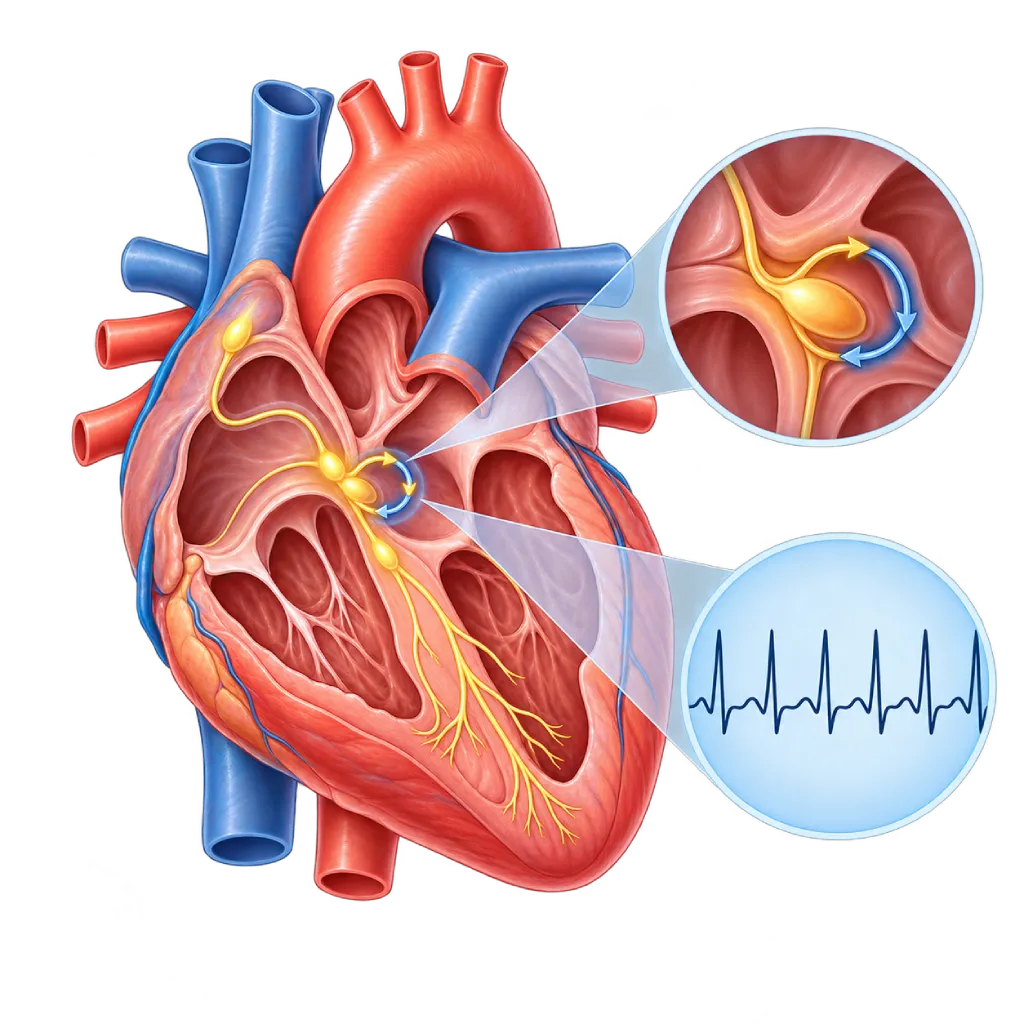
Supraventricular tachycardia (SVT) is an episode of fast, regular heartbeats coming from the atria or the AV node that starts and stops suddenly. It is usually not life-threatening and can be treated with vagal maneuvers, medicines, or ablation.
SourcesSigns That Need Urgent Help
- Fainting or nearly losing consciousness
- Severe chest pain
- Severe shortness of breath
- An episode that does not stop after the vagal maneuver your doctor taught you
- A racing heartbeat with cold sweats, paleness, and severe weakness
- A baby who is very limp, grayish pale, or refuses to feed
If these signs appear, go to the nearest emergency department right away or call Heart Attack Center 1500 258.
01 / Understanding the condition
About Supraventricular Tachycardia
Supraventricular tachycardia, often shortened to SVT, is a group of rhythm disorders that make the heart suddenly beat fast, usually above 150 beats per minute. The signal comes from the part above the ventricles, namely the atria or the AV node, the electrical gateway that passes signals from the atria to the ventricles. Its hallmark is that episodes start and stop suddenly, like a switch being turned on and then off.
Types of SVT
There are three main types. A commonly seen type is AVNRT, in which the signal circles between two small pathways around the AV node. The second type is AVRT, in which the signal circles through an extra electrical pathway, present from birth, between the atria and the ventricles. When this extra pathway is visible on an ECG during normal rhythm, the condition is covered on the Wolff-Parkinson-White Syndrome page. The third type is a fast signal from a single spot in the atria, covered on the Atrial Tachycardia page. Atrial fibrillation and atrial flutter also come from the atria but are covered separately because their treatment is different.
Who Gets It
SVT can appear at any age, including in babies, and often affects young people with healthy hearts. AVNRT is found more often in women, while AVRT more often appears for the first time in childhood or adolescence. Episodes can be triggered by caffeine, alcohol, lack of sleep, stress, or bending over, or they can appear without a clear trigger. In some women, episodes come back more often during pregnancy.
What Happens During an Episode
During an episode, the heart beats so fast that the ventricles do not have time to fill completely. You may feel a strong, regular pounding in your chest or neck, dizziness, shortness of breath, or chest discomfort. An episode can last from a few seconds to several hours. Afterward, some people feel tired or need to urinate.
SVT is usually not life-threatening and rarely damages the heart. However, repeated episodes can disrupt work, exercise, and your sense of security. SVT can be treated with vagal maneuvers, medicines, and catheter ablation, which in many patients eliminates episodes over the long term.
02 / Understanding the condition
Symptoms to Recognize.
Common Symptoms
- A very fast, regular heartbeat that starts suddenly
- Episodes that stop just as suddenly as they start
- A strong pulse felt in the neck
- Dizziness or light-headedness
- Shortness of breath or chest discomfort
- Weakness, anxiety, or sweating during an episode
- Needing to urinate after an episode ends
Symptoms in Infants
Babies cannot tell you that their heart is racing, so SVT is recognized by changes in their behavior, skin color, and breathing.
- Constant fussiness or, on the contrary, appearing very limp and sleepy
- Feeding poorly or stopping feeding
- Fast breathing or appearing to pant
- Pale or grayish, sweaty skin
- A heartbeat in the chest that can be seen or felt to be very fast
Symptoms in Children
Older children often describe an episode as the heart suddenly running or the chest feeling strange.
- Saying their heart is running or their chest is suddenly pounding
- Complaining of chest or stomach pain during an episode
- Suddenly stopping play and looking pale and weak
- Dizziness or feeling about to faint
- Episodes that often appear during exercise or when bending over
03 / Understanding the condition
What Causes This Condition?
- Two small pathways around the AV node that make the signal circle (AVNRT)
- An extra electrical pathway, present from birth, between the atria and the ventricles (AVRT)
- A single spot in the atria that sends fast signals on its own (atrial tachycardia)
- Episode triggers such as caffeine, alcohol, nicotine, lack of sleep, or stress
- An overactive thyroid gland or the effects of certain medicines
- Scar tissue after heart surgery, including surgery for congenital heart disease
04 / Understanding the condition
Who Is at Higher Risk?
Lifestyle
Too much caffeine, energy drinks, alcohol, smoking, stimulants, and lack of sleep can trigger episodes in people who already have a susceptible electrical pathway.
Medical
Thyroid disorders, congenital heart disease, and a history of heart surgery can make episodes appear more easily or come back more often.
Genetic
The extra electrical pathway is present from birth. A small number of cases are linked to other congenital conditions, such as Ebstein anomaly, and it rarely runs in families.
Age
SVT can appear in babies, children, teenagers, and adults. AVRT often appears earlier, while AVNRT more often starts to be felt between young adulthood and middle age.
Other
AVNRT is more common in women. In some women, episodes also appear more often during pregnancy.
Groups at Higher Risk
- Adult Women: AVNRT, a commonly seen type of SVT, is more common in women and usually starts to be felt between young adulthood and middle age.
- Pregnant Women: Changes in blood flow and hormones during pregnancy can make episodes more frequent. Treatment is chosen to be safe for the pregnancy and the baby.
- Babies and Children: SVT can appear in infancy. An episode in a baby that goes unrecognized for hours can strain the heart, so it needs to be checked right away.
- People with a Wolff-Parkinson-White Pattern: An extra electrical pathway visible on the ECG can trigger AVRT and needs a doctor's assessment, especially if symptoms appear.
- People with Congenital Heart Disease: Scar tissue after congenital heart surgery can become a place where signals circle and trigger tachycardia from the atria.
05 / Understanding the condition
How Is It Diagnosed?
The doctor will ask how episodes start and stop, how long they last, what triggers them, and what makes them ease. The diagnosis is confirmed with an ECG recorded during an episode. SVT usually appears as a fast, regular rhythm with narrow ventricular waves, because the signal still enters the ventricles through the normal pathway. An ECG taken between episodes is also important because it can show an extra electrical pathway.
Episodes have often stopped by the time you reach a healthcare facility. For this reason, the doctor may use a Holter monitor or a long-term recorder, and recordings from a smartwatch can be an early clue. Echocardiography assesses the structure of the heart, while blood tests check the thyroid. If ablation is planned, an electrophysiology study confirms the type of SVT and the location of the faulty pathway from inside the heart.
Electrocardiogram (ECG)
A recording during an episode shows a fast, regular rhythm with narrow ventricular waves. A recording between episodes may show an extra electrical pathway.
Holter Monitoring
Records the heart rhythm for 24 to 48 hours, useful when episodes occur almost every day.
Long-Term Heart Rhythm Monitoring
A recorder that is worn longer or that you activate yourself when you feel palpitations, used when episodes are infrequent.
Echocardiography
Assesses the structure and pumping strength of the heart, including looking for congenital heart disease that may accompany SVT.
Thyroid Function Test
Looks for an overactive thyroid gland, which can trigger or worsen a fast heart rate.
Electrophysiology Study
Confirms the type of SVT and the location of the faulty pathway from inside the heart, usually followed by ablation in the same session.
06 / Understanding the condition
Treatment Options.
Treatment is decided by a doctor after an assessment. The categories below can help you follow the conversation with your doctor.
Vagal Maneuvers
Simple techniques to stimulate the vagus nerve, such as blowing hard while straining, then lying down with your legs raised. This often stops an episode; your doctor will teach you a technique that is safe for you.
Injectable Medicine in the Emergency Room
If vagal maneuvers do not work, the doctor gives a short-acting injectable medicine under ECG monitoring to break the circuit.
Electrical Cardioversion
A controlled electric shock under brief sedation, used when an episode comes with a drop in blood pressure or does not stop with medicine.
Medicines to Prevent Recurrence
Beta blockers or calcium channel blockers can reduce episodes. The choice of medicine and the dose are determined by the doctor, including during pregnancy.
Catheter Ablation
The pathway that makes the signal circle is disabled through a catheter inserted from a blood vessel in the groin. Guidelines recommend ablation for recurrent, symptomatic SVT because it can eliminate episodes over the long term.
07 / Understanding the condition
Complications to Watch For.
Fainting and Injury
In some people, a very fast episode makes blood pressure drop, causing fainting and possible injury from a fall.
Tachycardia-Induced Cardiomyopathy
This is rare, but SVT that continues nonstop for weeks can weaken the heart muscle. It usually improves once the rhythm is controlled.
Heart Failure in Babies
An episode in a baby that goes unrecognized for hours to days can strain the heart, so the baby looks limp and short of breath.
Very Fast Heart Rate with an Extra Pathway
In people with an extra pathway, atrial fibrillation can be conducted very quickly to the ventricles. This is rare but needs a doctor's assessment and is often treated with ablation.
08 / Understanding the condition
What Can You Do?
- Identify and reduce your personal triggers, such as too much coffee, energy drinks, or alcohol
- Get enough sleep and manage stress
- Avoid smoking and stimulants
- Learn vagal maneuvers from your doctor and practice them when you are not having an episode
- Take preventive medicines as directed and do not stop them on your own
- Record an ECG during an episode if possible, then bring the result to your checkup
- Talk to your doctor about pregnancy plans if you have had SVT
09 / Understanding the condition
When Should You See a Doctor?
SVT should be checked even if the episodes stop quickly, so the type can be confirmed and the right treatment chosen. Make an appointment with a doctor if you have episodes of a racing heartbeat that start and stop suddenly, especially if they keep coming back. Go to the emergency room right away if an episode comes with danger signs or does not stop.
- Repeated episodes of a fast, regular heartbeat
- Episodes that make you dizzy, short of breath, or force you to stop what you are doing
- Your ECG has shown an extra electrical pathway pattern
- A baby or child looks pale, limp, breathes fast, or feeds poorly
- Fainting, chest pain, severe shortness of breath, or an episode that does not stop: go to the emergency room right away
Don't Wait in an Emergency.
If symptoms are severe or come on suddenly, go to the nearest emergency department right away or call Heart Attack Center 1500 258, rather than waiting for an appointment.
10 / Common questions
Questions You May Have.
Frequently asked questions about supraventricular tachycardia.
Is SVT dangerous?
For most people, SVT is not life-threatening and does not damage the heart. However, episodes can be very uncomfortable, cause dizziness, or lead to fainting. In people with an extra electrical pathway and in babies, a doctor's assessment is more urgent. For this reason, every episode of a racing heartbeat should be checked so the type can be confirmed and the risk assessed.
What is a vagal maneuver, and how do I do it?
A vagal maneuver is a way to stimulate the vagus nerve to slow the signals in the AV node so the episode can stop. One example is blowing hard while straining for about 15 seconds in a half-sitting position, then lying down right away with your legs raised. This technique should be learned directly from a doctor, because it is not suitable for everyone and some techniques are not recommended to do on your own.
Can ablation cure SVT?
Catheter ablation disables the electrical pathway that makes the signal circle. In many patients, SVT episodes do not come back after ablation, so guidelines recommend it for recurrent, symptomatic SVT. Like other procedures, ablation has risks, such as a rare disruption of conduction in the AV node. Your doctor will explain the benefits and risks based on your type of SVT.
Can SVT appear during pregnancy?
Yes. In some women, SVT episodes appear for the first time or come back more often during pregnancy. Vagal maneuvers can still be tried, and the doctor will choose medicines that are safe for pregnancy if needed. If you have had SVT and are planning a pregnancy, talk to your doctor beforehand, including about the possibility of ablation before pregnancy.
Can babies and children have SVT?
Yes. SVT is one of the rhythm disorders found fairly often in babies and children. Babies cannot tell you that their heart is racing, so the signs include fussiness, poor feeding, fast breathing, or pale skin. In some babies, SVT goes away on its own before one year of age, but until then it still needs treatment and monitoring by a doctor.
Can I exercise if I have SVT?
In general, yes. SVT without other heart disease is usually not a reason to stop exercising. If episodes often appear during exercise or come with severe dizziness, talk to your doctor about treatment, including ablation. Athletes and workers for whom fainting would be risky, such as drivers, need a specific assessment before returning to their activities.
Sources and Medical Review
Translated from the Indonesian edition medically reviewed by Dr. dr. Dicky A. Hanafy, Sp.JP(K).
Sources as cited in the Indonesian edition.
- Brugada J, Katritsis DG, Arbelo E, et al. 2019 ESC Guidelines for the management of patients with supraventricular tachycardia. The Task Force for the management of patients with supraventricular tachycardia of the European Society of Cardiology (ESC). Eur Heart J. 2020;41(5):655-720.
- Page RL, Joglar JA, Caldwell MA, et al. 2015 ACC/AHA/HRS Guideline for the Management of Adult Patients With Supraventricular Tachycardia. Circulation. 2016;133(14):e506-e574.
- Katritsis DG, Boriani G, Cosio FG, et al. European Heart Rhythm Association (EHRA) consensus document on the management of supraventricular arrhythmias, endorsed by Heart Rhythm Society (HRS), Asia-Pacific Heart Rhythm Society (APHRS), and Sociedad Latinoamericana de Estimulacion Cardiaca y Electrofisiologia (SOLAECE). Europace. 2017;19(3):465-511.
- Appelboam A, Reuben A, Mann C, et al. Postural modification to the standard Valsalva manoeuvre for emergency treatment of supraventricular tachycardias (REVERT): a randomised controlled trial. Lancet. 2015;386(10005):1747-1753.
- Philip Saul J, Kanter RJ, Abrams D, et al. PACES/HRS expert consensus statement on the use of catheter ablation in children and patients with congenital heart disease. Heart Rhythm. 2016;13(6):e251-e289.
- Kotadia ID, Williams SE, O'Neill M. Supraventricular tachycardia: An overview of diagnosis and management. Clin Med (Lond). 2020;20(1):43-47.
Doctors Who Treat This Condition

dr. Sunu B. Raharjo, Sp.JP(K), Ph.D.
Arrhythmia and Electrophysiology
Arrhythmia and Device Center
Clinical focusClinical and Interventional Electrophysiology · Cardiac Arrhythmia Ablation
View Profile
Dr. dr. Faris Basalamah, Sp.JP(K)
Interventional Cardiology
Coronary Intervention Procedures +1 center
Clinical focusComplex Coronary Intervention · Cardiac Electrophysiology
View Profile
Dr. dr. Dicky A. Hanafy, Sp.JP(K)
Arrhythmia and Electrophysiology
Arrhythmia and Device Center +1 center
Clinical focusElectrophysiology and Arrhythmia Ablation · Pacemaker and ICD Implantation
View Profile