
Quick answer
What Is Premature Ventricular Contraction?
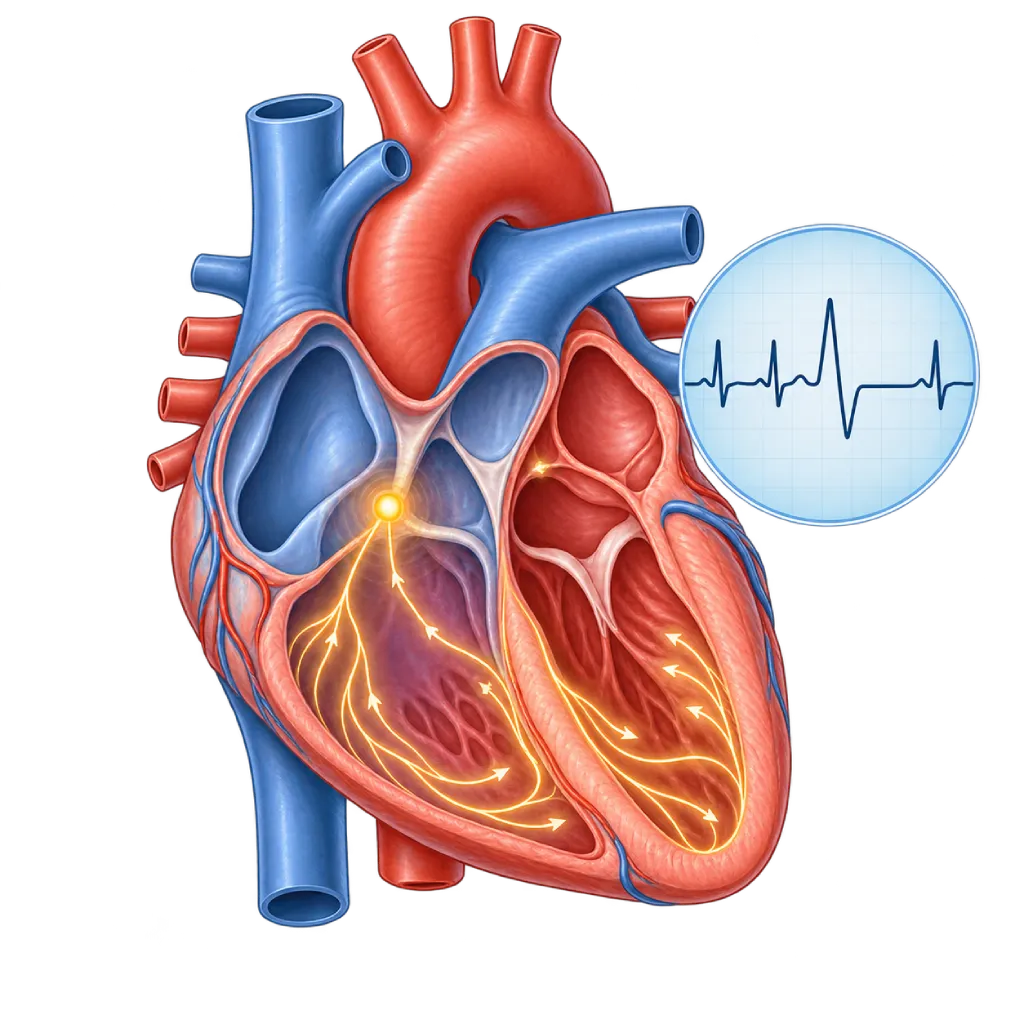
A premature ventricular contraction is an extra heartbeat from the lower chambers of the heart (ventricles) that comes earlier than it should. It is usually harmless in a healthy heart, but very frequent ones, or those that occur with heart disease, need further evaluation.
SourcesSigns That Need Urgent Help
- Fainting or nearly fainting, especially during exercise
- Rapid palpitations in a run that do not stop soon
- Chest pain or severe shortness of breath
- Palpitations with severe dizziness, paleness, or a cold sweat
- Sudden loss of consciousness and not breathing normally
If these signs appear, go to the nearest emergency department right away or call Heart Attack Center 1500 258.
01 / Understanding the condition
About Premature Ventricular Contraction
A premature ventricular contraction (PVC) is an extra heartbeat that starts in a lower chamber of the heart (ventricle), the pumping chambers at the bottom of the heart. Its signal appears before the normal signal from the sinus node arrives, so the ventricle contracts too early. There is usually a pause afterward, and the next beat feels stronger. On test results, a PVC is often written as VES or ventricular extrasystole.
A Common Finding
PVCs are found in many people when the heart rhythm is recorded over 24 hours, and they become more common with age. Most people do not feel them. Those who do usually describe the heart as skipping, pausing for a moment, or pounding hard in the chest or neck. Lack of sleep, stress, alcohol, and stimulants can make them more frequent. In some people, coffee can also slightly increase the number of PVCs.
The Condition of Your Heart Is What Matters
What a PVC means depends greatly on the condition of your heart. In a structurally normal heart, PVCs are usually benign. In people with coronary artery disease, scarring from a previous heart attack, cardiomyopathy, or inflammation of the heart muscle, PVCs can be a sign of an underlying disease that needs treatment. Doctors are also more cautious if the PVCs have various shapes, increase during exercise, or occur with fainting. For this reason, the main step in the evaluation is assessing the structure and pumping strength of the heart.
When PVCs Are Very Frequent
Very frequent PVCs, generally more than about 10 to 20 percent of all heartbeats in a day, can gradually weaken the heart's pumping function. This is called PVC-induced cardiomyopathy. Pumping function often improves after the number of PVCs is reduced with medication or ablation. That is why a Holter monitor is important for measuring the PVC burden, the percentage of PVC beats out of all heartbeats in a day.
Treatment
If the heart is healthy and PVCs are infrequent, an explanation and reducing triggers are often enough. If symptoms are bothersome, your doctor may prescribe a beta blocker or a calcium channel blocker, or certain antiarrhythmic medications. Catheter ablation can deactivate the source of the PVCs, especially if they are very frequent, cause severe symptoms, or weaken the heart's pumping function. Fast rhythms from the ventricles, which are more dangerous, are covered on the Ventricular Tachycardia page.
02 / Understanding the condition
Symptoms to Recognize.
Common Symptoms
Many people feel nothing at all. When they are felt, the symptoms are usually brief and come and go.
- A feeling that the heart skips or stops for a moment
- A single beat that feels very strong in the chest or neck
- Brief palpitations that come and go
- Mild chest discomfort
- Tiring easily when PVCs are very frequent
- No symptoms, found on an ECG or Holter monitor
03 / Understanding the condition
What Causes This Condition?
- A spot in the ventricular muscle that sends signals too early, often in the outflow tract of the right or left ventricle
- Lack of sleep, stress, alcohol, and stimulants, including energy drinks
- Low blood levels of potassium or magnesium
- An overactive thyroid gland
- Coronary artery disease or scar tissue after a heart attack
- Cardiomyopathy, inflammation of the heart muscle, or valve disease
- Certain medications, such as cold medicines containing decongestants or some asthma medications
04 / Understanding the condition
Who Is at Higher Risk?
Age
PVCs become more common with age, and in older adults they more often accompany heart disease.
Medical
High blood pressure, coronary artery disease, heart failure, cardiomyopathy, valve disease, and thyroid disorders are linked to more frequent PVCs.
Lifestyle
Lack of sleep, stress, alcohol, smoking, and stimulant drinks or substances can make PVCs more frequent or more noticeable.
Genetic
A family history of cardiomyopathy or sudden death at a young age means PVCs need a more careful evaluation, because they can be an early sign of an inherited disorder.
Groups at Higher Risk
- People with Heart Disease: Coronary artery disease, a previous heart attack, cardiomyopathy, and heart failure make PVCs more frequent and more important to evaluate.
- People with a High PVC Burden: PVCs that make up more than about 10 percent of daily heartbeats need monitoring because they can weaken the heart's pumping function.
- Families with a History of Sudden Death: PVCs can be an early sign of an inherited cardiomyopathy or electrical heart disorder.
- Older Adults: PVCs are more common and more often accompany heart disease in older age.
05 / Understanding the condition
How Is It Diagnosed?
Testing for PVCs answers three questions: how many PVCs there are, where they come from, and whether the heart is healthy. An ECG records the shape of the PVCs, which helps estimate where the signal starts. A Holter monitor worn for 24 to 48 hours measures the PVC burden, the percentage of PVCs out of all heartbeats in a day. An echocardiogram assesses the structure and pumping strength of the heart.
If PVCs are very frequent, have various shapes, or increase during exercise, or if there is a family history of sudden death, your doctor may recommend a cardiac MRI, a treadmill test, or other tests to look for cardiomyopathy and scar tissue. Blood tests check electrolytes and thyroid function. If ablation is planned, an electrophysiology study maps the source of the PVCs more precisely.
Electrocardiogram (ECG)
Records the shape of the PVCs; the shape helps your doctor estimate where in the ventricles the signal starts and look for signs of other heart disease.
Holter Monitoring
Counts the number of PVCs over 24 to 48 hours (the PVC burden) and looks for runs of consecutive beats.
Echocardiography
Assesses the structure and pumping strength of the heart, the main step in determining whether PVCs are benign.
Cardiac MRI
Considered if the echocardiogram is unclear, PVCs are very frequent, or cardiomyopathy or scar tissue is suspected.
Treadmill Stress Test
Shows whether PVCs decrease or instead increase during activity, which helps assess their risk.
Blood Electrolyte Test
Checks potassium and magnesium levels, which can trigger PVCs.
Electrophysiology Study
Maps the source of the PVCs from inside the heart when ablation is planned.
06 / Understanding the condition
Treatment Options.
Treatment is decided by a doctor after an assessment. The categories below can help you follow the conversation with your doctor.
Explanation and Monitoring
If the heart is healthy and the PVC burden is low, an explanation that this condition is usually benign, plus regular monitoring, is often enough.
Reducing Triggers
Get enough sleep, manage stress, limit alcohol and coffee if they trigger symptoms, and avoid energy drinks and stimulants.
Beta Blockers or Calcium Channel Blockers
Help reduce symptoms and the number of PVCs. Other antiarrhythmic medications are used in certain situations. Your doctor decides the type and dose.
Catheter Ablation
Deactivates the source of the PVCs using a catheter. Considered if PVCs are very frequent, very bothersome, or weaken the heart's pumping function.
Treating the Underlying Disease
Treating the coronary artery disease, heart failure, thyroid disorder, or electrolyte imbalance that is causing the PVCs.
07 / Understanding the condition
Complications to Watch For.
PVC-Induced Cardiomyopathy
Very frequent PVCs can gradually weaken the heart's pumping function. Pumping function often improves after the number of PVCs goes down.
Bothersome Symptoms
The feeling of skipped heartbeats can disturb sleep and daily activities, and can cause anxiety.
More Dangerous Ventricular Arrhythmias
In structural heart disease, PVCs can accompany or trigger ventricular tachycardia, so the underlying disease needs treatment.
08 / Understanding the condition
What Can You Do?
- Get enough sleep and manage stress
- Limit alcohol and coffee if you notice more palpitations afterward
- Avoid energy drinks, smoking, and stimulants
- Read cold medicine labels and ask a pharmacist if they contain decongestants
- Control your blood pressure, cholesterol, and blood sugar to keep your heart healthy
- Repeat Holter monitoring and echocardiography as your doctor advises if your PVCs are frequent
09 / Understanding the condition
When Should You See a Doctor?
A skipping heartbeat sensation should be checked at least once to confirm its type and assess the condition of your heart. Make an appointment with a cardiologist if:
- Your heart feels like it skips very often or every day
- Your ECG or Holter results show many PVCs
- You have heart disease, have had a heart attack, or tire easily and feel short of breath
- A family member died suddenly at a young age or has cardiomyopathy
- Palpitations appear or increase during exercise
- Palpitations come with fainting, chest pain, or severe shortness of breath: go to the emergency room right away
Don't Wait in an Emergency.
If symptoms are severe or come on suddenly, go to the nearest emergency department right away or call Heart Attack Center 1500 258, rather than waiting for an appointment.
10 / Common questions
Questions You May Have.
Frequently asked questions about premature ventricular contractions, or extra beats from the ventricles.
Are PVCs dangerous?
In a structurally normal heart, PVCs are usually benign and do not increase the risk of sudden death. PVCs need attention if they are very frequent, occur in runs, increase during exercise, or if you have heart disease or a family history of sudden death. That is why your doctor will assess the condition of your heart, usually with an echocardiogram and a Holter monitor.
What is PVC burden?
PVC burden is the percentage of PVC beats out of all heartbeats in a day, calculated from a Holter recording. For example, a burden of 10 percent means one in ten heartbeats is a PVC. A high burden, generally above 10 to 20 percent, can weaken the heart's pumping function if it lasts a long time, so it needs monitoring and sometimes treatment.
Can I exercise if I have PVCs?
If your heart is healthy and your PVCs decrease or disappear during exercise, physical activity is generally safe and recommended. If your PVCs instead increase during exercise, occur in runs, or you experience dizziness and fainting, stop strenuous exercise and get checked. Your doctor may recommend a treadmill test or a cardiac MRI before you return to training.
Does coffee cause PVCs?
The link differs from person to person. One study showed that drinking coffee can slightly increase the number of PVCs on that day, but coffee in moderate amounts is generally not harmful to the heart. If you notice more palpitations after coffee, strong tea, or energy drinks, cut back and watch for changes. Energy drinks high in caffeine should be avoided.
When is ablation recommended for PVCs?
Ablation is considered if PVCs are very frequent and cause bothersome symptoms, if medications do not help or are not suitable, or if the PVCs are suspected of weakening the heart's pumping function. For PVCs from the right ventricular outflow tract, ablation can often eliminate the source. Your doctor will explain the benefits, risks, and chances of success based on where your PVCs come from.
Can PVCs go away on their own?
Yes. The number of PVCs often rises and falls over time and can decrease after triggers such as lack of sleep, stress, or alcohol are reduced. In some people, PVCs persist for years without causing problems. If your PVC burden is high, your doctor will usually repeat Holter monitoring and echocardiography regularly to make sure your heart's pumping function stays good.
Sources and Medical Review
Translated from the Indonesian edition medically reviewed by dr. Sunu B. Raharjo, Sp.JP(K), Ph.D..
Sources as cited in the Indonesian edition.
- Zeppenfeld K, Tfelt-Hansen J, de Riva M, et al. 2022 ESC Guidelines for the management of patients with ventricular arrhythmias and the prevention of sudden cardiac death. Eur Heart J. 2022;43(40):3997-4126.
- Marcus GM. Evaluation and Management of Premature Ventricular Complexes. Circulation. 2020;141(17):1404-1418.
- Arnar DO, Mairesse GH, Boriani G, et al. Management of asymptomatic arrhythmias: a European Heart Rhythm Association (EHRA) consensus document, endorsed by the Heart Failure Association (HFA), Heart Rhythm Society (HRS), Asia Pacific Heart Rhythm Society (APHRS), Cardiac Arrhythmia Society of Southern Africa (CASSA), and Latin America Heart Rhythm Society (LAHRS). Europace. 2019;21(6):844-845.
- Cronin EM, Bogun FM, Maury P, et al. 2019 HRS/EHRA/APHRS/LAHRS expert consensus statement on catheter ablation of ventricular arrhythmias. Heart Rhythm. 2020;17(1):e2-e154.
- Baman TS, Lange DC, Ilg KJ, et al. Relationship between burden of premature ventricular complexes and left ventricular function. Heart Rhythm. 2010;7(7):865-869.
- Ling Z, Liu Z, Su L, et al. Radiofrequency ablation versus antiarrhythmic medication for treatment of ventricular premature beats from the right ventricular outflow tract: prospective randomized study. Circ Arrhythm Electrophysiol. 2014;7(2):237-243.
- Marcus GM, Rosenthal DG, Nah G, et al. Acute Effects of Coffee Consumption on Health among Ambulatory Adults. N Engl J Med. 2023;388(12):1092-1100.
Doctors Who Treat This Condition

dr. Sunu B. Raharjo, Sp.JP(K), Ph.D.
Arrhythmia and Electrophysiology
Arrhythmia and Device Center
Clinical focusClinical and Interventional Electrophysiology · Cardiac Arrhythmia Ablation
View Profile
Dr. dr. Faris Basalamah, Sp.JP(K)
Interventional Cardiology
Coronary Intervention Procedures +1 center
Clinical focusComplex Coronary Intervention · Cardiac Electrophysiology
View Profile
Dr. med. dr. Denio A. Ridjab, Sp.JP(K)
Interventional Cardiology
Coronary Intervention Procedures +2 centers
Clinical focusInterventional Cardiology · Coronary Artery Disease
View Profile